


Background Information
Official name: Republic of Ghana
Official language: Official language English.
Over 25 ethnic languages.
Over 25 ethnic languages.
Population: 30.4 million people (2020 est.)
Life expectancy 64 years.
President isNana Addo Dankwa Akufo-Addo.
Parliament has 275 members
Gross Domestic Product (GDP) in Ghana was worth 67 billion US dollars in 2019.
The contribution of agriculture to the country’s GDP has suffered decline since 2009 from 31.8% to about 17.3 % as of 2019.
Export products are gold, cocoa, timber, bauxite manganese and electricity.Oil was found in 2007.
Economy relies heavily on foreign assistance and remittances from Ghanaians abroad. Currency is Ghana Cedi (GH¢).
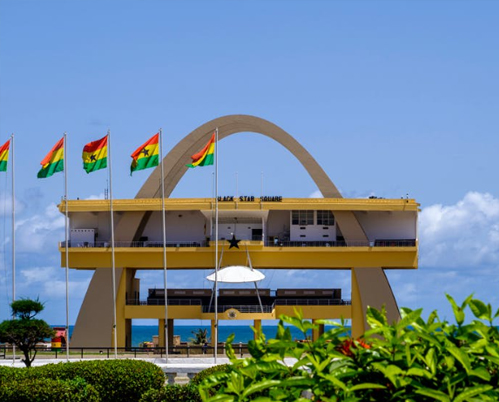
Popular tourist destination

Summary
Ghana, a country on the West Coast of Africa, is one of the most thriving democracies on the continent. It has often been referred to as an "island of peace" in one of the most chaotic regions on earth. It shares boundaries with Togo to the east, la Cote d'Ivoire to the west, Burkina Faso to the north and the Gulf of Guinea, to the south. A recent discovery of oil in the Gulf of Guinea could make Ghana an important oil producer and exporter in the next few years.
The country's economy is dominated by agriculture, which employs about 40 percent of the working population. Ghana is one of the leading exporters of cocoa in the world. It is also a significant exporter of commodities such as gold and lumber. A country covering an area of 238,500 square kilometres, Ghana has an estimated population of 30.4 million (2020 est.), drawn from more than one hundred ethnic groups - each with its own unique language. English, however, is the official language, a legacy of British colonial rule.
In 1957, Ghana (formerly known as the Gold Coast) became the first country in sub-Saharan Africa to gain independence. After leading the country for nine years, the nation's founding president, Kwame Nkrumah was overthrown in a coup d'etat in 1966. After Kwame Nkrumah, Ghana was ruled by a series of military despots with intermittent experiments with democratic rule, most of which were curtailed by military takeovers. The latest and most enduring democratic experiment started in 1992 and it is what has gained recognition for Ghana as a leading democracy in Africa.
Ghana has several tourist attractions such as the castles. Most of the major international airlines fly into and from the international airport in Accra. Domestic air travel is thriving and the country has a vibrant telecommunications sector, with six cellular phone operators and several internet service providers.
More information
FAQ. Frequently Asked Questions about Ghana
Travel Advice
Hotels
Famous people
Dictionary: typical Ghanaian Expressions
Business Telephone Directory