From mother-to-child transmission to sexual contact, tattoos and the sharing of sharp instruments, Dr Philip Nyinaku, Senior Public Health Physician Specialist at the 37 Military Hospital, has shed light on some common ways hepatitis B can be transmitted.
According to him, mother-to-child transmission remains one of the major routes of infection in Ghana, making antenatal screening and treatment during pregnancy critical in reducing the spread of the disease.
“Mother-to-child transmission is one of the major modes of transmission that we have in Ghana. It is important that when women are pregnant, they go for their checks,” he said in an interview on GTV monitored by GhanaWeb on July 28, 2026.
Dr Nyinaku explained that pregnant women who test positive must receive appropriate treatment to reduce their viral load, while babies born to infected mothers should receive immunoglobulin and vaccination to prevent infection.
He said targeting newborns is key to achieving the global goal of eliminating hepatitis B, noting that Ghana could make significant progress towards the 2030 target if prevention measures are strengthened.
Explaining the cause of hepatitis B, Dr Nyinaku said the disease is caused by a virus and falls among the five major types of viral hepatitis: A, B, C, D and E.
He noted that while hepatitis A and E are mainly spread through contaminated food and water, hepatitis B, C and D are transmitted through body fluids and blood products.
“For hepatitis B, C and D, once you mention vertical transmission, that is, mother-to-child transmission, and then also through body fluids and blood products,” he said.
He listed sexual intercourse, sharing sharp objects, tattoos, ear piercing and the use of unsterilised instruments by traditional practitioners as some of the ways the virus can spread.
Dr Nyinaku, however, clarified that hepatitis B is not transmitted through casual contact such as coughing, swimming together or ordinary interaction.
He explained that infections spread through contaminated food and water mainly relate to hepatitis A and E, which are usually self-limiting and do not commonly become chronic.
More than 15,000 Ghanaians died of Hepatitis in 2022
“If my hands are contaminated and I handle your food and you take it, you can get it. But that one will resolve on its own,” he said.
World Hepatitis Day is observed annually on July 28 to raise global awareness of hepatitis, a group of infectious diseases known as hepatitis A, B, C, D and E, and to encourage prevention, diagnosis and treatment.
JKB/BAI
Watch as court takes over Cheddar’s prime property on Osu Oxford street
Health News of Tuesday, 28 July 2026
Source: www.ghanaweb.com
World Hepatitis Day: Expert explains major routes of transmission
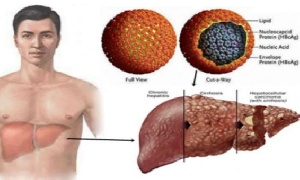 A medical illustration showing Hepatitis B infection