Professor Benedict Calys-Tagoe, Head of the Department of Community Health, University of Ghana Medical School (UGMS), says the limited availability of cancer registries is hampering data-driven cancer care in Ghana.
“We are not able to have a reliable national data because of the absence of well-functioning cancer registries,” he noted, saying, currently, there were only two recognised cancer registries in the country – the Kumasi Cancer Registry and the Accra Cancer Registry.
Prof Calys-Tagoe, speaking on the topic, “Taming the Crab: Insights into Cancer Care in Ghana”, at an inaugural lecture organised by the University of Ghana, Legon, in Accra, cited how cancer registries represented the foundation of any rational cancer care.
They served as essential tools for collecting, analysing, and disseminating cancer-related data, the medical scientist observed.
“These registries are systematic and they collect data that provides valuable insights into cancer trends, patient demographics and the effectiveness of human protocols.
“By maintaining comprehensive records, the registries contribute significantly to public health initiatives, research advancement and the development of targeted interventions that are aimed at improving patient care,” he explained.
Giving a situational analysis on cervical cancer, Prof Calys-Tagoe highlighted that the nation lacked reliable data on the proportion of women with the disease (precancer or invasive) who had received treatment, revealing that the World Health Organisation’s target was 90 per cent.
Cervical cancer is the second most prevalent cancer in females, with high mortality rates.
“This is something that we need to take up as a country and run with. Every year, it comes up on the budget for the non-communicable diseases, but unfortunately that is where it has remained,” he bemoaned.
Generally, cancer remains a significant public health concern in the country, recording approximately 27, 385 new cases and 17,944 deaths annually, according to health authorities.
The most common cancers in Ghana are breast and cervical (for females), prostate and liver (for males), and retinoblastomas and lymphomas (for children).
Prof Calys-Tagoe’s work deeply involved cancer research, focusing on breast and cervical cancers and the development of cancer registries in resource-limited settings.
His research aims to improve early detection, rational control, treatment access and public awareness of cancers.
He is advocating the establishment of population-based cancer registries with clearly defined sustainable funding, decentralising cancer screening and treatment services, improving and expanding funding sources of the NHIS so they can pay realistic tariffs to service providers to encourage service delivery.
In his recommendations, the medical scientist notes that about a third of the common cancers reported in Ghana are preventable (through vaccinations, lifestyle modifications, and reducing exposure to risk factors).
“About a third are potentially curable if detected early through screening and prompt treatment,” he affirmed, adding that about a third would require palliation, focusing on symptom control, pain relief, psychosocial and spiritual support, and overall improvement in the quality of life.
Health News of Monday, 6 April 2026
Source: GNA
Cancer care in Ghana hampered by inadequate registries - Medical scientist
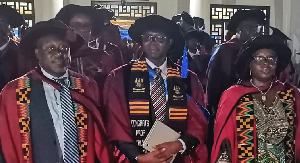 Professor Benedict Calys-Tagoe(middle) is the Head of the Department of Community Health UGMS