The Education Ministry has attributed some of the challenges surrounding the 2026 Computerised School Selection and Placement System (CSSPS) to the overwhelming demand for Category A senior high schools.
According to the Ministry, more than four times as many candidates who selected Category A schools as their first choice were competing for the available spaces in those institutions.
Only 35% of 2026 BECE candidates scored aggregates 6-24 – CSSPS
Press Secretary to the Minister for Education, Hashmin Mohammed, said 313,283 candidates chose Category A schools as their first choice, while only 76,417 vacancies were declared by schools in that category.
Speaking on JoyNews’ The Pulse on Monday, September 7, 2026, Mohammed explained that the issue was not a shortage of vacancies across the country but rather the concentration of candidates around a relatively small number of highly sought-after schools.
He said the CSSPS had declared 859,828 vacancies across schools nationwide, a figure significantly higher than the number of candidates who sat for the Basic Education Certificate Examination (BECE).
“The system, the CSSPS system declared a vacancy of 859,828. So if you look at the vacancy in the system, it is even far more than the number of candidates who sat for the exams,” he said.
Mohammed said schools such as Achimota School and Presbyterian Boys’ Secondary School (Presec) continued to attract exceptionally high demand from candidates.
He said the number of candidates seeking places in Category A schools far exceeded the vacancies available.
“The declared vacancy by the heads of the schools starts at 76,417 as against the number of students who showed interest in Category A schools this year alone, which is 313,283,” he said.
He explained that candidates who failed to secure their first-choice schools because of competition were considered for the subsequent choices they had submitted.
This means a candidate could be placed in their second, third, fourth or fifth choice, provided they met the requirements for the selected school and programme.
“So, when you are faced with that challenge, of course, some students will not be able to be placed in their preferred school,” he said.
According to Mohammed, the placement process therefore operated based on the choices submitted by candidates.
The Education Ministry has also rejected concerns that some candidates were placed in schools they did not select.
Mohammed said the selection process was expanded this year to allow candidates to choose up to eight schools. He explained that the additional choices were intended to give the placement system more alternatives when a candidate could not secure their preferred school.
“It is impossible for you to pass and then you will be allocated into a school you haven't chosen because that's why we expanded the choices,” he said.
He urged parents and candidates who believe they have been placed in schools they never selected to first check the original choices submitted during the selection process before concluding that an error had occurred.
Mohammed also confirmed that candidates who obtained a score of nine in English Language or Mathematics are eligible to access the self-placement system.
The self-placement portal has been opened to candidates who were not automatically matched, allowing eligible candidates to select from schools and programmes with available vacancies.
The 2026 CSSPS results were released on September 4, with 527,932 candidates successfully placed out of 604,567 qualified candidates. This represents an 87.3 per cent placement rate.
The placement figures show that Category A schools recorded the highest demand, with 313,283 candidates selecting them as their first choice.
Category B schools recorded 176,614 first-choice selections, while 123,577 candidates selected Category C schools as their first choice.
In terms of available spaces, Category A schools declared 76,417 vacancies, compared with 250,366 vacancies in Category B schools and 468,652 in Category C schools.
To address concerns arising from the placement exercise, the Ministry has established placement resolution centres at both the regional and national levels.
The centres are expected to assist candidates and parents who encounter difficulties or have concerns about their placements.
The Ministry is also relying on the self-placement process as an alternative pathway for qualified candidates who were not automatically matched to a school.
NA/AM
General News of Monday, 7 September 2026
Source: www.ghanaweb.com
Education Ministry explains why many BECE candidates missed Category A schools
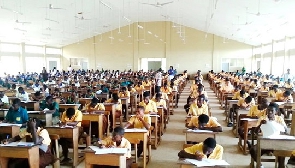 A file photo of BECE candidate writing exams




Entertainment