Dr Mahamudu Bawumia has proposed a clear path to tackling illegal mining by formalising small-scale mining, providing incentives and supporting operators to transition into medium-scale mining.
Speaking during an engagement with the Ghana National Association of Small-Scale Miners in Accra on Thursday, Dr Bawumia said small-scale miners were not the problem but could be part of the solution if properly supported.
He recalled that when he introduced the Domestic Gold Purchase Programme, he deliberately invited small-scale miners to his office to ensure that the policy did not disadvantage them.
“I wanted to make sure that in pursuing this programme, we did it without disadvantage to the small-scale miners,” he said.
Dr Bawumia said small-scale miners now produce more than 52% of Ghana’s gold, having overtaken large-scale mining companies for the first time. He noted that their production also feeds directly into the Gold-for-Reserves programme, which he said has contributed to the stability of the cedi.
He argued that the best way to protect small-scale miners while improving the integrity of the mining sector is to provide formalised operators with access to affordable financing, modern equipment, geological data and security of tenure. This, he said, would enable them to expand their operations, create more jobs, pay increased royalties and adopt more environmentally responsible mining practices.
According to him, providing legitimate opportunities for young people to participate in the mining sector would also reduce the incentive for illegal mining, which often thrives when young people lack viable alternatives.
Dr Bawumia added that his 2028 manifesto would focus on practical support for professionals and workers, including engineers, farmers and miners, stressing the need to be prepared to implement policies from the first day in office.
“If you are not prepared to move on day one, you are going to be in trouble,” he said.
To address what he described as one of the biggest challenges facing local miners—access to capital—Dr Bawumia reiterated his proposal to establish a Minerals Development Bank.
“This bank will be for small-scale miners to help them access funds for responsible mining equipment,” he explained.
He said the proposed bank would provide financing for viable local mining projects and help Ghanaian miners acquire the equipment needed to operate efficiently and safely while protecting the environment.
“With the right tools, our miners can work efficiently and safely, building wealth for themselves and their communities without compromising the environment,” he said.
Dr Bawumia said the Minerals Development Bank would be established in collaboration with relevant state institutions, including the Minerals Income Investment Fund (MIIF) and the Bank of Ghana, as well as the private sector.
“We want to establish a Minerals Development Bank to finance viable local mineral projects and to mitigate foreign financing of local mining projects, which leads to heavy smuggling of the produce afterwards,” he said.
He explained that many Ghanaian small-scale miners currently rely on foreign financiers because of the high capital requirements of mining, a situation he said often results in limited Ghanaian ownership and contributes to gold smuggling.
Under the proposed arrangement, the Minerals Development Bank would assess the viability of miners’ concessions and provide financing that could be repaid with interest as the miners operate.
“This will allow Ghanaians to own 100% of their concessions,” he said.
Dr Bawumia linked the proposed bank to other mining reforms, including decentralising the Minerals Commission and Environmental Protection Authority (EPA) to mining districts; establishing District Mining Committees, including traditional authorities, to issue temporary licences; involving the Geological Survey Department in mapping gold deposits to reduce trial-and-error mining; and establishing equipment pools and common-user gold processing facilities.
General News of Friday, 28 August 2026
Source: www.ghanaweb.com
Scaling up small-scale mining key to tackling galamsey – Bawumia
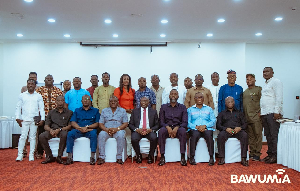 Bawumia proposes Minerals Development Bank to support small-scale miners with funding



Entertainment

Van Vicker 'slaps' LilWin with GH¢10m defamation suit


Opinions