Former Vice President and NPP Presidential Candidate, Dr Mahamudu Bawumia, has disclosed what he describes as a “hidden” conditionality in Ghana’s IMF programme that constrained the foreign exchange market and contributed to the rapid depreciation of the cedi between 2022 and 2024.
Speaking on Thursday during a meeting with members of the Ghana Small-Scale Miners Association in Accra, Dr Bawumia said the IMF programme had capped the Bank of Ghana’s foreign exchange market interventions at a maximum of $80 million per month.
“One of the restrictions for the IMF programme that we engaged in was the amount of foreign exchange that the central bank could use to intervene to support the cedi. We were given a maximum of $80 million a month,” he said.
According to him, the cap meant the Bank of Ghana could use a maximum of $960 million a year to support the cedi, an amount he said was far below Ghana’s monthly demand for foreign exchange to finance fuel, machinery, medicine and other imports.
“So, we were really constricted in terms of availability of foreign exchange. And at the same time, the cedi was depreciating almost on a daily basis,” he said.
Dr Bawumia explained that the restriction formed part of the IMF’s reserve accumulation strategy but had the unintended effect of creating foreign exchange scarcity in the market.
He said the restriction was lifted in January 2025 after Ghana had built sufficient foreign exchange reserves through the Gold for Reserves programme, which he said he had proposed to the Bank of Ghana during the economic crisis.
“Because we had built up the foreign exchange reserves through Gold-for-Reserves, that restriction was removed. And since then, the Bank of Ghana has been able to put in at least $1 billion a month in the market,” he said.
He contrasted the current level of intervention with the previous cap, saying:
“From $80 million maximum per month, or $960 million per year, to $1 billion a month. We couldn't even do $1 billion a year before.”
Dr Bawumia said the increased availability of foreign exchange following the removal of the restriction has contributed to the stability of the Ghanaian cedi.
General News of Friday, 28 August 2026
Source: www.ghanaweb.com
IMF $80m forex intervention cap strangled cedi between 2022 and 2024 – Dr Bawumia
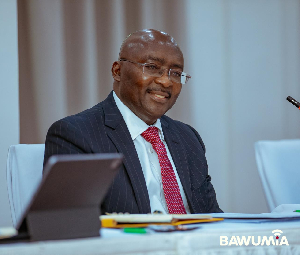 Dr Mahamudu Bawumia is a former Vice President




Entertainment

Van Vicker 'slaps' LilWin with GH¢10m defamation suit


Opinions