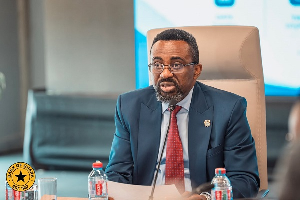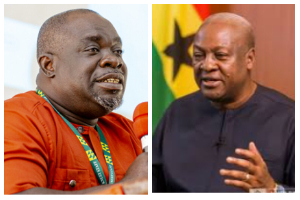
Provost of the College of Humanities and Social Sciences at KNUST, Professor Charles Marfo, has stated that President John Dramani Mahama’s administration’s recent approval rating should fall below 15%.
According to the former president of the University Teachers Association of Ghana (UTAG), the ruling government has disappointed ordinary citizens despite the high expectations placed on it.
Speaking on a panel discussion on Oyerepa TV in a video shared on social media, he said the ruling National Democratic Congress (NDC) government has failed to meet public expectations and needs to be held accountable.
“NDC is in power and they should step in and open the Afari Hospital. That is why people are saying that the president’s approval rating is going down. For me, I believe it should have dropped even lower than what we are seeing below 15%.
“When it drops, it will make him sit up. Some of us had so much confidence in them, but look at what is happening. When they came into office, they started with the Krofuom Market. Have they completed the Kumasi market? They are disappointing the people, and someone should tell them,”he said.
Meanwhile, a new survey by the Institute of Economic Affairs (IEA) released on Wednesday, June 10, 2026, found that the President's job approval rating stands at 58.9 per cent, down from 68 per cent recorded in an earlier IEA survey conducted in December 2025 and published in February 2026.
The poll, which was conducted in May 2026 across all 16 regions with more than 1,000 respondents, showed that 28.4 per cent of respondents disapproved of President Mahama's performance, while 12.8 per cent expressed no opinion.
Despite the decline, the IEA noted that the President still maintains a significant lead between approval and disapproval ratings.
"The decline suggests that while many Ghanaians remain supportive of the President, they increasingly expect improvements in the economy to be reflected in their daily lives," the institute stated in its report.
The survey found that economic performance remains the strongest factor behind public support for the President.
Among respondents who approved of his performance, 73.5 per cent cited the government's handling of the economy as their main reason, while 16 per cent pointed to road infrastructure development.
Energy and electricity accounted for 2.7 per cent of responses.
Global InfoAnalytics: Mahama’s approval rating drops from 73% in July to 67%
According to the IEA, key economic indicators have improved over the past 16 months. Inflation declined from 23.5 per cent in January 2025 to about 3.4 per cent in April 2026, while the cedi appreciated by 26 per cent against major foreign currencies.
The report also noted that the Bank of Ghana's policy rate fell from 27 per cent to 14 per cent, with average commercial bank lending rates dropping from approximately 32 per cent to around 20 per cent.
In addition, Ghana's debt-to-GDP ratio declined from 61.8 per cent at the end of 2024 to 45.3 per cent by the end of 2025, while international ratings agencies upgraded the country's sovereign credit rating.
However, economic concerns also featured prominently among those dissatisfied with the President's performance.
"About 30.9 per cent cited the economy as their main concern," the IEA said, adding that the findings "may point to a disconnect between improvements in national economic indicators and the day-to-day experiences of many households, particularly regarding incomes and the cost of living."
Electricity supply emerged as the second most common concern among respondents who disapproved of the President's performance, with 29.9 per cent citing power-related challenges.
The institute observed that the survey was conducted shortly after temporary power supply difficulties in May 2026 led to frequent outages in parts of the country.
Corruption was also identified as a major concern, with 19.1 per cent of dissatisfied respondents citing it as a reason for their disapproval.
"The findings suggest that many Ghanaians continue to expect visible action in addressing corruption," the IEA noted.
Overall, the institute concluded that while support for President Mahama remains relatively strong, Ghanaians are looking for economic gains to translate into tangible improvements in their everyday lives.
The survey forms part of the IEA's regular assessment of presidential job performance.
@focusparker President Mahama's performance has been disappointing. His approval ratings should be around 15% by now and not 58%.-Prof Charles Marfo. #npp #ndc #jm #nanaaddo #afarimilitaryhospital ♬ original sound - Kwesi Parker-Wilson
AM
Engineers' body calls for mandatory verification of foundations before concrete works