A leading member of the governing NDC, Professor Kwamena Ahwoi has stated that the Ashanti Kingdom could easily have developed into an independent country, pointing to its strong historical political organisation, cohesion, and state-like structures prior to colonial incorporation.
According to him, excessive decentralisation could pose a serious threat to Ghana’s unity if not carefully handled.
Speaking in a snippet from a press conference shared on Facebook on May 20, 2026, Professor Ahwoi explained that while decentralisation promotes local governance and development, it can also create conditions that encourage separatist tendencies and eventual disintegration of states.
According to him, countries must strike a delicate balance between decentralisation and national cohesion.
“In decentralising, you must be aware that there are separatist tendencies. It is very easy to move from decentralisation to separation, to federalism, to balkanisation, to secession and to the breakdown of the country,” he warned.
Professor Ahwoi noted that Ghana’s decentralisation structure intentionally maintains weak regional powers partly to prevent any threat to national unity.
He further argued that Ghana, like many African countries, is largely a colonial creation and should not assume its current borders and unity are permanently guaranteed.
Decentralisation when effectively implemented increases accountability – Minister
“Don’t ever think that Ghana can remain or will remain Ghana forever. Ghana, like almost all African countries, with the exception of Ethiopia and Liberia, is an artificial colonial construct,” he stated.
The former minister explained that prior to colonial intervention, powerful kingdoms such as the Ashanti Empire could have evolved into independent states.
“In fact, it is most likely that Ashanti would have conquered the rest of Ghana. They have not, because the British just stopped them,” he said.
Professor Ahwoi stressed that historical empires and strong traditional states within Ghana still possess identities that could potentially fuel separatist sentiments if decentralisation is not properly managed.
“So, when you have an artificial construct like that, with a very strong empire, and Ashanti was an empire, and you say you are decentralising, you must watch what you do,” he cautioned.
Although he praised past Ashanti leaders for helping preserve national unity, he warned that a divisive leader could destabilise the country.
Ghana's decentralisation will not succeed on policies, structures alone – Segbefia
“Fortunately, we have had very wise Ashanti leaders who have not created a problem. But if you get an Ashanti leader who is troublesome, you can create problems for the nation of Ghana,” he said.
To support his argument, Professor Ahwoi cited examples from global history, including the collapse of the Soviet Union and Yugoslavia.
He explained that countries such as Ukraine, Kosovo, and Bosnia and Herzegovina were once part of larger political unions that eventually fragmented into separate states.
“There was Yugoslavia, which broke up into six different countries… and then there was the USSR, the Union of Soviet Socialist Republics, which was made up of 15 different republics,” he recounted.
Professor Ahwoi also referenced the Nigerian Civil War, explaining how regional structures and strong ethnic leadership nearly led to the breakup of Nigeria.
He recalled how Lieutenant Colonel Chukwuemeka Odumegwu Ojukwu declared the independent state of Biafra, triggering a brutal civil war that lasted three years.
“By the end of that war, one million people had died,” he noted.
Professor Ahwoi concluded that while decentralisation remains important for governance and development, Ghana must avoid adopting systems that could unintentionally encourage division or secessionist movements.
“The lesson this teaches us is that decentralisation is good, but if you don’t take care, it can be a great danger to the unity of the state,” he stated.
“We don’t want to fashion out a governance system that will give an excuse for Ghana to break up,” he added.
Watch video below
VPO/SEA
General News of Wednesday, 20 May 2026
Source: www.ghanaweb.com
Ashanti Kingdom could have easily been a country - Prof Ahwoi
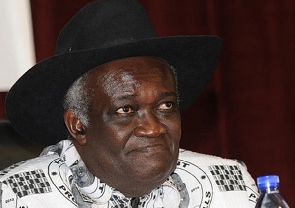 Professor Kwamena Ahwoi is a leading member of NDC