There is so much beauty in poetry. And when combined with sign language, it is phenomenal.
When I decided to organise an Expressive Poetry Competition for Deaf students at the Demonstration School for the Deaf in Ghana, many people debated as to whether it was possible and were wondering what exactly it would even look like. Their scepticism probably stemmed from the fact that they had not seen poetry in that form yet.
However, on the 26th of June, 2026, at the Demonstration School for the Deaf, Mampong-Akuapem, Ghana, the answer to that question was delivered as each of the remarkable children took the stage during the Expressive Poetry Competition. And it was undeniably tangible.
According to the World Health Organization and Deaf Child Worldwide, there are approximately 34 million Deaf children globally with most living in low- and middle-income countries. There is also a deficit of early sign language introduction for most Deaf children in this region. This opens up the opportunity to address the contributory factors and how to change the status quo.
The United Nations Convention on the Rights of Persons with Disabilities (CRPD), Article 24, requires the facilitation and learning of sign language to promote the linguistic identity of the Deaf community within inclusive education systems. Furthermore, UNICEF's Disability Inclusion Policy and Strategy 2022–2030 supports sign language access as part of its broader commitment to full participation for children with disabilities by 2030. It is essential that children with disabilities also get to enjoy SDG 4 (Quality Education for All).
Dr Adzeley's Expressive Poetry and Mini Spelling Competition is a direct, community-level response to this global imperative.
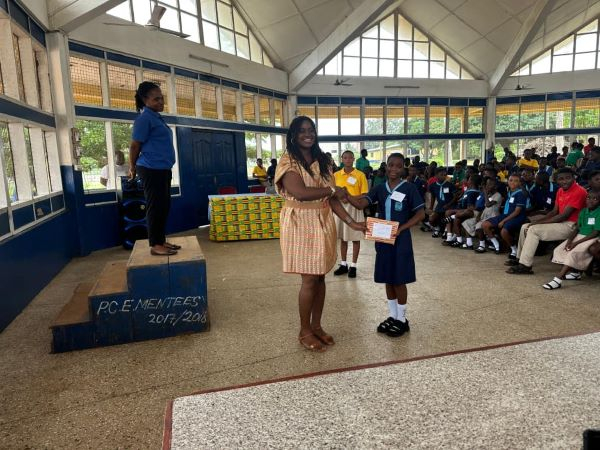
The day opened with a warm-up Mini Spelling Competition with a total of 31 words (ranging from everyday vocabulary to civic concepts such as Parliament, Citizenship, and Leadership). Some of the teachers at the school served as sign language interpreters for moments when the poems were being read out while the contestants performed. Children fingerspelled their answers and were given the opportunity to ask for definitions when they needed them. Comprehension and expression were treated as inseparable necessities throughout the competition and the contestant with the most correct answers was ultimately crowned overall best winner of the mini spelling competition .
Next on the program outline was the Expressive Poetry competition. This was governed by rules. All poems were original. Judging was done by three selected teachers and contestants were assessed on six categories: originality and creativity, clarity of theme and message, sign language craft ( including handshape, spatial grammar, and use of stage), emotional impact through facial grammar and body expression, structural coherence, and age-appropriate achievement across three groups: Kindergarten, Primary, and Junior High.
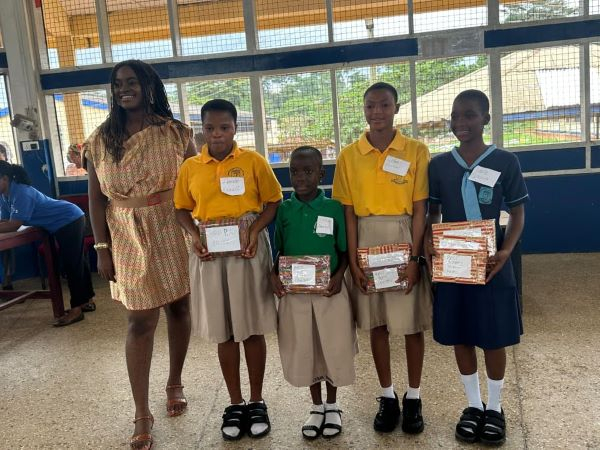
Prizes recognised multiple forms of excellence, including an Overall Best Poetry Contestant, age-group awards, and a People's Choice Award that gave the community (pupils and students in the audience) an opportunity to cast their vote.
"It was really exciting and enjoyable. We wish to continue for the next competition. We are grateful to the organizer for this program".
"I like the competition. It is good for acting and drama. I also like the other competition, it is important for spelling"
"I want more of such activities. I feel happy and I am very interested in this subject".
"The competition was sweet, good and easy for me. I need you to add another one- Dance".
These are the words of some of the contestants who participated in the poetry and spelling competitions.
The teachers also expressed how they felt about the program as well:
"Even though this is the first time, I really love the way the learners were participating with their full talent and ability. I wish this will continue".
"I liked the competition because it was well organized, exciting and gave everyone a chance to show their skills and talents. It was also a good opportunity to learn from others and build confidence".
"The fact that the deaf can also recite poems; Deaf can indeed speak. More of such competitions on bigger platforms".
This initiative is grounded in peer-reviewed evidence.
A 2025 review by Dostal and colleagues found that incorporating sign language into instruction in formal education settings improves language access and supports the learner in areas such as acquiring new vocabulary, comprehension, and composition. These are the essentials and fundamentals of understanding and creating good poems.
There is also evidence that experience and learning with a visual and spatial language enhances spatial cognition and visual imagery in Deaf signers which is also relevant and similarly seen in sign language poetry.
Research as far back as 1993 by Emmorey and colleagues shows that experience with a visual-spatial language enhances Deaf signers' visual imagery and spatial cognition, abilities that are considered essential in the artistry of signed poetry. Building on this, a 2014 study in the Journal of Deaf Studies and Deaf Education found that signed poetry forges a uniquely embodied connection between poet and audience, rooted in Deaf culture and linguistic experience.
Children born into hearing families, make up over 90% of Deaf children globally; in this group, sign language poetry may be the first time they witness their own language treated as an art form. Every child deserves the right to see the beauty of their first language in all its glory and experience it as an art. This Expressive Poetry Competition model in Ghana offers proof of this possibility.
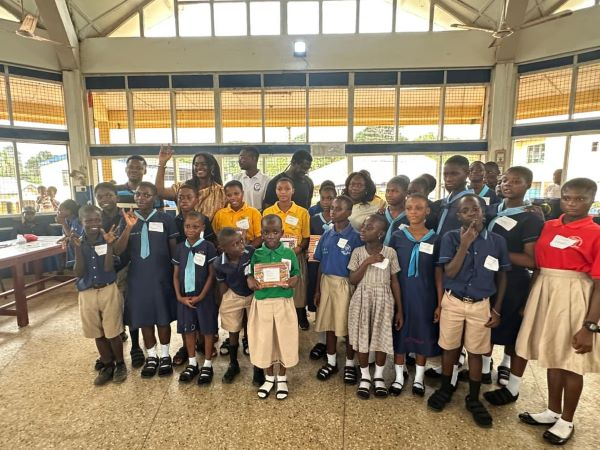
The children at the Demonstration School for the Deaf showcased their creativity, courage, and artistry proudly when the opportunity presented itself.
The full competition is available here: https://youtu.be/EIaXJm80IT4
The world has 34 million reasons to scale this model for Deaf children in every country because each contestant who stood on that stage showed how it was possible.
Regional News of Saturday, 18 July 2026
Source: Dr Naa Adzoa Adzeley Boi-Dsane, Contributor
Expressive Poetry in Ghanaian Sign Language: Honouring deaf children's creative and linguistic rights
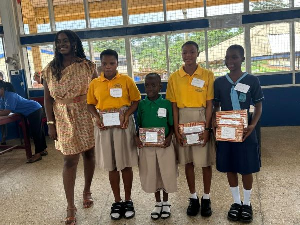 Dr Naa Adzoa Adzeley Boi-Dsane awarded someof the students


Entertainment

How Ghanaian entertainers paid tribute to Sway DaSafo


Opinions