Twenty-eight participants from across Africa have gathered at the Kofi Annan International Peacekeeping Training Centre (KAIPTC) for the fifth edition of the Gender Advisers’ Course, a capacity-building programme aimed at strengthening gender-responsive peace and security across the continent.
The programme seeks to strengthen the practical integration of gender perspectives into institutional policies, decision-making processes and operational responses to peace and security challenges.
It also brings together Gender Advisers, Gender Experts and Gender Focal Points to enhance their capacity to translate gender equality commitments into practical and measurable outcomes within their respective organisations.
The initiative is being delivered in partnership with the Folke Bernadotte Academy (FBA), with support from the ECOWAS Peace, Security and Governance (EPSG) Project and its partners, including the German Corporation for International Cooperation (GIZ), the European Union and the Government of Denmark. The ECOWAS Gender and Development Centre also provides regional institutional support.
Opening the course, the Deputy Commandant of KAIPTC, Brigadier General Lawrence Deku, underscored the importance of integrating gender perspectives into all phases of peace and security policies, programmes and operations, noting that effective responses must account for the different ways conflict and insecurity affect women, men, girls and boys.
He emphasised that gender mainstreaming must not be treated as an additional responsibility to be considered after operational decisions have been made, but as an integral component of effective, inclusive and sustainable peace and security efforts.
“The challenge before us is to bridge the gap between commitment and practice,” he noted, highlighting the strategic role of Gender Advisers in supporting institutional decision-making, applying gender-analysis tools, influencing organisational thinking and promoting accountability for gender-related commitments.
The relevance of the course is reflected in its growing record of institutional contribution and its response to the practical challenges faced by gender practitioners. Since the programme was introduced in Ghana, more than 80 participants have benefited from the training, which is being delivered for the fifth time in the country.
An evaluation conducted in 2026 examined the long-term results, relevance, effectiveness, institutional contribution and sustainability of the four cohorts delivered by KAIPTC in partnership with FBA between 2021 and 2025.
According to the evaluation findings presented at the opening, the course has contributed to building a network of gender expertise across African countries and supporting progress in the implementation of the Women, Peace and Security (WPS) agenda. Reported outcomes include increased women's representation on peace councils, the translation of WPS commitments into regional action, the establishment of gender structures within institutions, the development of gender-responsive policies and the deployment of gender officers to peacekeeping missions.
The findings also highlight the practical challenges that Gender Advisers must navigate, including institutional resistance, cultural norms and the need for stronger strategic advisory skills. These realities reinforce the importance of equipping practitioners not only with technical knowledge, but also with the ability to engage leadership, influence colleagues and support organisational change.
The course is grounded in the recognition that progress in developing international, continental and regional frameworks must be matched by the capacity to implement them effectively. While policies establish commitments, their impact depends on how institutions translate them into everyday decisions, operational plans and accountable practices.
Speaking on behalf of the EPSG project partner consortium, Theresa Kraft emphasised that gender mainstreaming is essential to understanding conflict dynamics, protecting civilians, strengthening participation and building sustainable peace.
She highlighted the strategic position of Gender Advisers in helping organisations translate commitments into plans, plans into practice, and practice into measurable results. The course, she noted, is designed around the real needs of practitioners and seeks to strengthen their ability to advise leadership, support operational teams and improve accountability for gender-responsive action.
Representing FBA, Senior Specialist on Women, Peace and Security and Course Director of FBA’s Global Gender Adviser Course, Kristin Valasek, highlighted the value of bringing together gender practitioners from across the continent.
She observed that Gender Advisers and Focal Points often work independently or in small teams while navigating similar institutional challenges. The course therefore offers an important opportunity for participants to exchange experiences, share good practices and develop professional networks that can support their work beyond the training period.
This peer-learning approach is central to building a stronger community of practice, enabling participants to draw on diverse national and institutional experiences while identifying practical approaches suited to their own organisational contexts.
Beyond the immediate training, the programme reflects a broader commitment to strengthening the availability of specialised gender expertise across the peace and security sector.
Growing demand from national institutions and individual practitioners for specialised training in gender mainstreaming and advisory functions points to the need for sustained capacity development opportunities across the region. KAIPTC has expressed its commitment to taking a leading role in mobilising resources, delivering and institutionalising the course beyond 2026.
Building on the expertise developed through the programme, training materials provided by FBA and the Centre’s existing infrastructure and institutional capabilities, KAIPTC aims to support the regular delivery of the course and expand access to specialised gender training.
This commitment also presents an opportunity to strengthen the long-term sustainability of the initiative and respond to the needs of institutions seeking to build or reinforce their internal gender capacities.
The 2026 Gender Advisers’ Course contributes to ongoing efforts to advance the Women, Peace and Security agenda, anchored in United Nations Security Council Resolution 1325 and subsequent commitments recognising women's meaningful participation in conflict prevention, peace processes, peacekeeping and post-conflict recovery.
Through facilitator-led sessions, practical exercises, group discussions, simulations and experience-sharing, participants will strengthen their understanding of gender-analysis tools, develop strategies for advising colleagues and leadership, and enhance their capacity to integrate gender perspectives into institutional policies and operational activities.
As the course progresses, its ultimate value will lie in how participants apply their learning within their organisations, helping to shape more responsive policies, strengthen institutional accountability and ensure that peace and security interventions better reflect the different needs and experiences of the populations they serve.
For KAIPTC and its partners, the programme represents a continued investment in the people and institutional capabilities needed to advance inclusive, gender-responsive and sustainable peace and security across Africa.
Regional News of Thursday, 29 October 2026
Source: KAIPTC
KAIPTC brings together 28 African practitioners for gender-focused security training
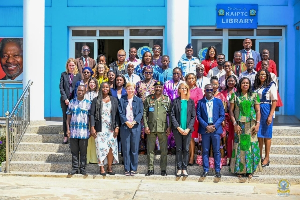 Photo of some diginitaries in a group picture after the program