The public has been urged to step up efforts in conserving water while guarding against wastage.
They must also report illegal water connections and leakages in their respective communities to help improve access to potable water across the country.
“Water is the only resource on earth that touches everything, from health and education to gender equality and economic growth.
“Do not let taps run unnecessarily. Water saved in your school could mean water available for a community in Teshie or Adenta. Small acts can make a big difference,” the Chief Regional Manager of Ghana Water Limited (GWL) Accra East, Dr Richard Appiah Otoo, has said.
He was speaking during an event organised by his outfit to commemorate this year’s World Water Day celebration in Accra yesterday, on the theme, “Water and gender: Where water flows, equality grows.”
It was aimed at educating students on the value of water, and to also inspire them to become part of the solution in improving water supply and management.
In attendance were students from Achimota SHS and the staff of GWL.
Dr Otoo said globally, women spent about 250 million hours daily fetching water, which he said affected their education and overall development.
“Every hour a girl spends carrying water is an hour she is not in the classroom. Fix the water problem, and you free the future,” he said.
Dr Otoo said GWL was undertaking initiatives to promote gender inclusion within the water sector, including mentorship programmes aimed at increasing female participation in leadership roles.
He said involving more women in decision-making processes was essential to addressing challenges that disproportionately affected them.
“You cannot solve a problem that affects women the most if they are not present at the decision-making table,” the manager added.
Challenges
Dr Otoo, however, acknowledged the challenges facing water supply in Accra, saying that the city required millions of gallons of water daily, which sometimes strained the system.
He cited incidents such as the recent burst of a major 42-inch transmission pipeline in January, which disrupted water supply to some communities in the eastern corridor of Accra for days.
The manager also mentioned illegal water connections, which he said continued to undermine the company’s efforts to ensure equitable distribution of water.
Dr Otoo encouraged students to consider careers in engineering, science, policy-making, and other relevant fields related to the water sector, adding that the future of water management rested on them.
Water protection
The Public Relations and Communications Manager for the region, Nana Yaw Barima Barnie, also stressed the need to protect fresh water, while advising the public to contribute to the fight against water pollution.
For his part, the Water Quality Assurance Manager of GWL, Moses Paintsil, said that although an off-river reservoir concept had been introduced as a key intervention to improve water treatment, the sustainability of the system remained threatened by ongoing illegal mining activities, which degraded raw water sources.
He cautioned that without tackling illegal mining, even advanced treatment interventions such as off-river reservoirs might not be sufficient to guarantee a safe and reliable water supply in the country.
Regional News of Thursday, 26 March 2026
Source: Bright Donkor, Contributor
GWL urges public to conserve water, report leakages
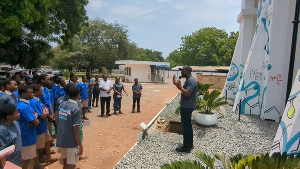 Ghana Water Limited has urged the public to conserve water, and report leakages


Entertainment