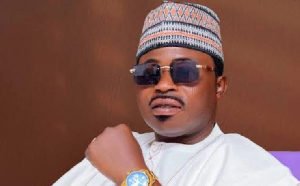
A former spokesperson on governance and security for the previous administration has strongly advised President John Dramani Mahama to improve his performance on national security, asserting that his current handling of the sector is inadequate.
The former spokesperson, Dr Palgrave Boakye-Danquah, specifically criticised the President for his handling of the former Chief Justice’s removal, emphasising that the decision carries serious security implications for Ghana—implications President Mahama appears to have overlooked.
Speaking during an interview with Kwabena Agyapong on the Frontline programme on Rainbow Radio 87.5FM, Dr Boakye-Danquah argued that the removal of the Chief Justice generated negative international publicity among global investors and observers.
“The removal of the Chief Justice had detrimental implications for Ghana. Investors and observers worldwide, who have historically viewed Ghana as stable, now perceive our judicial arm of government as potentially lacking independence. The removal of Gertrude Torkornoo was, in essence, a judicial coup d’état.
"After years of preserving our democracy, President Mahama has needlessly removed a sitting Chief Justice, thereby undermining the independence of the Judiciary,” he stated.
He further described the appointment of Richard Jakpa “who was dishonourably removed from a previous position” as another egregious security lapse by the government.
“In any serious nation, Richard Jakpa would have no place in the national security architecture. This was a dangerous decision that compromises Ghana’s safety. On security matters, President Mahama has earned a failing grade,” Dr Boakye-Danquah said.
He added that Ghana is currently unsafe under President Mahama and expressed confusion over the delay in appointing a substantive Minister of Defence and submitting the nominee for vetting by Parliament’s Appointments Committee.
Dr Boakye-Danquah lamented the surge in violent clashes across the country, citing several recent incidents: a chieftaincy dispute in Nkwanta South that claimed three lives; a clash in Bawku on April 9th resulting in one fatality and several injuries; renewed conflicts in Nkwanta South with three additional deaths and a violent land dispute at Gbiniyiri in the Sawla-Tuna-Kalba District of the Savannah Region, which reportedly claimed at least 31 lives and displaced nearly 48,000 people.
He warned that the growing instability could severely compromise public health and safety, increasing the risk of outbreaks of infectious diseases such as new strains of fever, cholera or COVID-19.
Dr Boakye-Danquah stressed that the government, led by President Mahama, must urgently address the rising tide of clashes and associated fatalities nationwide.
“The country is not secure; consequently, President Mahama is underperforming on security. It appears he is not in control of security measures. He also claims he has refrained from declaring a state of emergency because his national security has not advised him to do so.
"He possesses the authority to override their advice and declare a state of emergency. Ghana is not safe, and we are unequivocally telling His Excellency that Ghana is not safe,” he declared.
Dr Boakye-Danquah added that essential food sources such as kontomire, cassava and cocoyam are becoming scarce due to illegal mining (“galamsey”), yet President Mahama’s response has been inadequate.
“As a matter of urgency, he must declare a state of emergency to safeguard Ghana,” he urged.
Regarding an assessment of the administration’s governance, Dr Boakye-Danquah noted that the government has demonstrated some positive performance, assigning it a score of 50 percent out of 100.
He explained that governance is predicated on transparency, trust and accountability areas where he believes the President has shown modest success.
“I score him 50 percent on governance, although nine months is arguably too short a period for a comprehensive evaluation. Governance hinges on trust, accountability, and transparency.
"He has met with the press and established a code of ethics for his appointees. On these three criteria, he is performing commendably. He continues to benefit from public goodwill,” he observed.
Politics of Wednesday, 8 October 2025
Source: rainbowradioonline.com
Ghana is no longer safe under President Mahama – Dr Boakye-Danquah
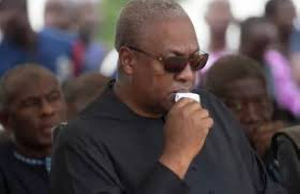 John Dramani Mahama is the President of Ghana


Entertainment