Vice President Professor Naana Jane Opoku-Agyemang has called for stronger international cooperation and ethical recruitment practices to address the growing migration of healthcare professionals from Ghana and other African countries.
Speaking at the 2026 Annual Health Summit in Accra on June 9, 2026, the Vice President stressed the need for bilateral labour agreements that balance opportunities for health workers abroad with the need to safeguard Ghana's healthcare system.
She noted that while the migration of healthcare professionals presents opportunities for skills development and economic advancement, it also poses significant challenges for countries struggling to maintain adequate numbers of health workers to serve their populations.
Prof Opoku-Agyemang said Ghana's response to the challenge must include deliberate investments in training, recruitment, deployment and retention of health workers, particularly in underserved communities.
As part of these efforts, she announced government's plans to recruit 16,000 health professionals, including community health nurses, midwives, physician assistants, and public health officers, to strengthen healthcare delivery and advance the country's Universal Health Coverage agenda.
The Vice President emphasised that recruitment alone would not solve the challenge of workforce shortages, highlighting the importance of creating conditions that encourage health professionals to remain in service, especially in rural and deprived areas.
She called for stronger collaboration among government agencies to improve housing, transportation, security, and other social amenities that influence where health workers choose to work and live.
Addressing the summit, Prof Opoku-Agyemang also renewed calls for African countries to take greater ownership of their health systems through increased domestic investment and reduced dependence on external support.
She described the Accra Reset on Health Sovereignty as a transformative framework aimed at building resilient and self-reliant healthcare systems across the continent through local capacity development and sustainable financing.
Minister of Health, Kwabena Mintah Akandoh, acknowledged that workforce retention remains one of the most pressing challenges confronting Ghana's health sector.
"Our challenge today is not simply training more health workers. It is employing them, deploying them equitably, motivating them, supporting them and retaining them," he said.
The minister outlined measures being implemented to strengthen the health workforce, including the recruitment of additional health professionals, expansion of specialist and post-basic training programmes and improved deployment to underserved communities.
He noted that despite progress in healthcare access and insurance coverage, staffing shortages continue to affect some parts of the country, particularly rural areas.
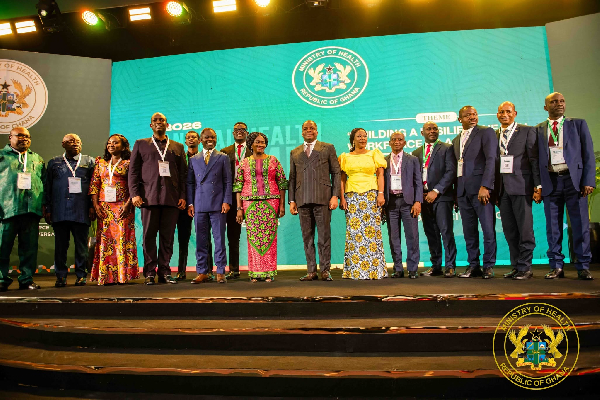
This year's Annual Health Summit was held under the theme, "Building a Resilient Health Workforce to Accelerate the Attainment of Universal Health Coverage."
The event brought together development partners, heads of agencies under the Ministry of Health, members of Parliament's Health Committee and health professional regulatory bodies to discuss strategies for strengthening Ghana's health workforce and healthcare system.
'He said he wanted to die' - Sister of Adenta building collapse victim speaks
Health News of Wednesday, 10 June 2026
Source: Ministry of Health
Vice President calls for ethical recruitment agreements to protect Ghana's health workforce
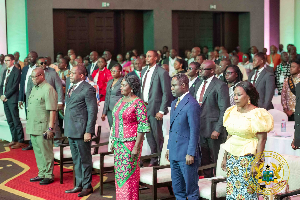 The Vice President among some dignitaries at the event



Entertainment