Felicia Konadu, Health Promotion Manager at the Sunyani Municipal Directorate of the Ghana Health Service (GHS), has urged families to encourage sexually active adolescent girls to access adolescent health corners for counselling and guidance.
She explained that the adolescent health corners, established in public health facilities, are designed to address the sexual and reproductive health needs of young people, particularly girls.
Mrs Konadu noted that “whether we like it or not, some girls can’t change from engaging in unhealthy pre-marital sex and we must therefore counsel, guide and protect them from pregnancies and sexually transmitted infections.”
She advised that if adolescent girls cannot control their sexual desires and appetites, then they must be supported to make informed decisions.
Mrs Konadu gave the advice when speaking at a community forum and radio outreach clinic in Sunyani, urging that girls ought to understand sex to either abstain or protect themselves.
The Global Media Foundation (GloMeF), a human rights and media advocacy Non-Governmental Organisation (NGO), in collaboration with its local partners organised the forum under its project dubbed “Resilient City for Adolescents” (RCA) implementation.
GloMeF is partnering with the Citizens Watch Ghana (CWG) and Indigenous Women Empowerment Network (IWEN) to implement the RCA under the Healthy Cities for Adolescents (HCA-II) Programme, an initiative of Foundation Botnar through Ecorys UK Limited.
The day’s forum created a platform for adolescents, stakeholders, and community members to discuss key issues affecting adolescent well-being as well as promoting awareness, participation, and informed decision-making among young people.
Mrs Konadu also urged teachers to create a safe environment and promote friendly relationships among adolescents, especially girls, so that they could easily approach them on sexual reproductive care.
“We must also shape them to understand characteristics of adolescents and guide them to practice proper personal hygiene too,” she stated, and cautioned the youth against substance abuse and alcoholism.
She commended GloMeF and its partners for the execution of the RCA project, testifying that the project was making significant impacts on the lives of the youth.
Patricia Awuah, the Bono Regional Guidance and Counselling Coordinator of the Ghana Education Service (GES), advised teachers to ensure that issues related to adolescent sex were referred to the health directorate or the adolescent health corners.
She said that the GES upholds and promotes abstinence and urged teachers to encourage adolescents to abstain from unhealthy pre-marital sexual practices that endanger their health and well-being.
Earlier, Jesse Sarkodie, Programmes Manager of IWEN, explained that the RCA project aimed at empowering adolescents socially, politically, and economically to actively participate in decision-making processes.
Health News of Saturday, 23 May 2026
Source: GNA
GHS urges families to encourage sexually active girls to use adolescent health corners
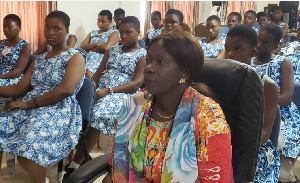 A woman is seen seated with students