The Centre for Sustainable Development Initiatives (CENSUDI), in collaboration with the Cancer Screening Unit of the Bolgatanga Central Hospital and the Ghana Health Service (GHS), has organised free cervical and breast cancer screening for women and students in the Nabdam District.
The outreach programme, a pilot of which was held at the Nyogbare Community-based Health Planning and Services (CHPS) Compound and scheduled to continue at the Kotintabig CHPS Compound and other communities in the Upper East Region, formed part of CENSUDI’s Cervical Health Advocacy (CenCerHeAd) project.
The project is being supported by individual donors, including Kenneth and Carol Stecher; Barbara L. Wuest; Dale Hodges and David Logan; Tom Stecher and Janet Thornbury; Manik and Eileen Saini; Marget Napoka Saine; Mainerd & Christine Sorensen; Rosemary Atia-Walker, William and Margaret Stanford, as well as Beyond Boundaries-Syracuse, USA.
It was aimed at increasing the cervical screening rates in the Upper East to 50 per cent by 2030.
The national screening rate currently stands at 16.8 percent.
Franciska Issaka, the President of CENSUDI, said her personal battle with cervical and breast cancers inspired her advocacy efforts.
She recounted surviving abnormal cervical cells detected during routine screening in 1989 and later overcoming breast cancer, describing herself as both a “previvor” and a survivor.
“There is so much attention on breast cancer, but not enough on cervical cancer. Yet cervical cancer is preventable and the second leading cancer killer of our women in Ghana. With HPV vaccination before girls become sexually active and regular screening, we can eliminate it,” she said.
Issaka explained that CENSUDI, founded in Ghana in 1989 and registered in the United States in 2011, focuses on strengthening communities by promoting excellence in women and girls.
According to her, the decision to focus on underserved communities was informed by low awareness levels and instances where long distances prevented women from accessing screening services located at the Bolgatanga Hospital and beyond the boundaries of the region.
She emphasised that CENSUDI selected the Nabdam District to pilot the CenCerHeAd activities because the district recorded less than 90 per cent vaccination coverage during the Government of Ghana’s Human Papillomavirus (HPV) vaccination rollout in November 2025.
“We believe that the women who came today will become ambassadors when they return home and share their experiences so that others will be encouraged to also get screened,” she said.
Issaka urged all women up to 65 years old to take advantage of screening opportunities whenever they arise.
Roger Tandanbil, an Oncology Nurse Specialist at the Upper East Regional Hospital, described cervical cancer as a “silent disease” that often presents no symptoms in its early stages.
“This screening is very important because cervical cancer does not show signs and symptoms in its early stages. By the time symptoms appear, the disease may have advanced,” he explained.
“In this part of the country, screening rates are very low, yet cases continue to be recorded,” he stated, attributing the situation to inadequately trained personnel, long distances to health facilities, and financial challenges.
Tandanbil said the team was targeting more than 100 women during the Nyogbare exercise but remained prepared to screen additional participants if turnout exceeded expectations.
Layibil Yensogre, a beneficiary, said it was her first time undergoing screening for both breast and cervical cancer and expressed appreciation to CENSUDI for the initiative.
Agnes Baa, another participant, also indicated that it was her first cervical cancer screening and pledged to champion awareness in her community to encourage regular check-ups.
Belinda Sapak, a 16-year-old student of Nyogbare Junior High School, described the programme as empowering, stating that she and her colleagues aged 15 years and above did not benefit from the HPV vaccine rollout, which targeted only girls aged nine to 14 years.
She therefore commended CENSUDI for extending the outreach to the community.
Health News of Sunday, 22 February 2026
Source: GNA
CENSUDI, GHS take free cervical, breast cancer screening to Nabdam communities
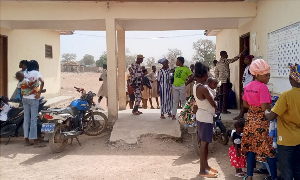 Some residents during the screening exercise