The Breast Society of Ghana has sounded the alarm on a looming surge in the incidence of breast cancer in Ghana as the menace of illegal mining (galamsey) continues to ravage many communities across the country.
It indicated that an average of 5,000 women were diagnosed with the disease every year, out of which 2,500 died, but the situation could deteriorate if the galamsey onslaught did not cease immediately.
Prof Martin Morna, an Associate Professor with the School of Medical Sciences (SMS) of the University of Cape Coast (UCC) and member of the Society, warned that mercury, lead, arsenic, and other chemicals introduced into water bodies and the soil were carcinogenic and could increase the susceptibility of women to breast cancer.
The Society issued the warning when it held a grand durbar on breast cancer awareness in Cape Coast, sensitising mostly second-cycle students to the fatal disease and mounting a strong advocacy against stigmatisation.
The durbar highlighted the devastating dangers of breast disease and called for love and support for victims, instead of stigma and ostracisation.
The mammoth gathering was held under the Society’s Empowerment Project as part of its 13th Oguaa Breast Cancer Campaign on the theme: “Breast cancer: Stop the stigma and be supportive.”
Prof Morna underscored the dangers of the disease, noting that cancer cells could invade other organs and parts of the body, including the bone, brain, and liver, and cause them to fail.
He said the disease could happen to anybody, but factors such as age, gender, race, family history, smoking, nulliparity, contraception, and delaying the first birth until 30 years increased the risk of getting it.
He said early signs of the disease included bloody or blackish discharge from the breast, adding that the early signs were usually not painful or bothersome.
“Anyone who goes beyond 40 years and finds a lump in their breast should quickly see the doctor,” he said.
“It is good to do screening regularly; do it once every two years if you are at average risk, and once every year if you are at high risk,” he added.
Prof Akwasi Anyanful, Former Vice President of the Society and Associate Professor with UCC SMS, painted a global picture of the breast cancer disease, noting that 2.3 million cases were recorded in 2022 alone, out of which 665,000 succumbed.
He observed with worry that the incidence of breast cancer was higher among Caucasians, but mortality was higher among blacks.
He also observed that breast cancer could also affect men, adding that men died faster when affected.
“Breast cancer is no respecter of persons, and let us all be advocates of breast cancer. Let us let the world know that early detection saves lives,” he said.
Mrs Georgina Kumah-Dzagah, a survivor of breast cancer, shared her experience with the disease and how she suffered stigma at the hands of friends and family.
She said she had gone through all the stages of the disease, including lumpectomy, mastectomy, radiotherapy, hormonal therapy, and chemotherapy, even though she detected the disease at an early stage.
“The deepest wound doesn’t come from the cancer but how people respond to it. I was 31 years old when I was diagnosed, and my world changed in an instance.
“I didn’t just lose my breast, I lost friends. Social gatherings became more painful because people looked at my chest instead of my face,” she recounted.
She emphasised that breast cancer was real but not contagious, urging people to be more supportive of patients.
Prof Rofela Combey, Provost of the College of Agriculture and Natural Sciences, UCC, who chaired the gathering, also shared her experience with caring for a breast cancer patient and how much stigma he suffered.
“He was initially diagnosed with malaria and high fever, but we later found out it was breast cancer,” she recalled.
“The day we become more human, the world will be a better place. The pain may be real, but love will make it bearable,” she added.
Prof Georgina Yaa Oduro, the Head of the Sociology and Anthropology Department at UCC, led the Society to launch a book on breast cancer dubbed “Breast Cancer: Diagnosis, Treatment, Facts and Myths.”
The book uses pictures, illustrations, and simple language to explain breast cancer, how it comes, and how it can be fought.
Copies of the book were distributed to various institutions and groups, including health facilities, security services, and Senior High Schools.
Prof Oduro commended the Breast Society of Ghana for its consistent advocacy and support for breast cancer patients in Ghana.
The Breast Society of Ghana later embarked on breast cancer awareness and health walks through some principal streets of Cape Coast.
More than 700 Senior High School students, security personnel, and other professionals joined the Society in the walk to educate and sensitize the public to the disease.
The walk culminated in an aerobics session at Victoria Park.
Health News of Tuesday, 14 October 2025
Source: GNA
Galamsey threatens spike in breast cancer cases - Breast Society warns
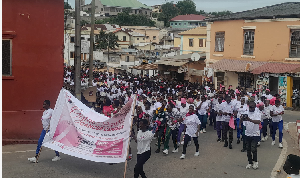 Breast Society seen embarking on a walk