The College of Health and Allied Sciences (CoHAS) of the University of Cape Coast (UCC) and the Convention of Biomedical Researchers Ghana, have jointly held their 2025 scientific conference with a call for deeper collaboration between industry and academia to drive Africa’s health sector.
The biennial event, which promotes research and scientific dialogue, brought together researchers, policymakers, health professionals, faculty, and students to champion a more resilient healthcare system, with particular emphasis on biomedical and clinical research.
This year’s gathering marked the second CoHAS conference and the 15th Convention of Biomedical Researchers Ghana (CoBREG) conference, on the theme: “Biomedical and Clinical Research in Africa: Connecting Scientists for Future Innovations.”
Professor Ellis Owusu Dabo, a Professor of Epidemiology and Global Health, stressed the need for stronger industry-academia partnerships, warning that without such synergy, the continent’s scientific output would have limited real-world impact.
He bemoaned the low academia-industry engagement in Ghana, which was less than five per cent across all sectors.
“Industry has the money, technology, and equipment, while students and faculty aspire to use them. By working together, students will be more fit-for-purpose right from school,” he said.
He cautioned that the many theses, patents, and research ideas produced in universities would remain on library shelves if not linked to industry for development and scale-up.
“At the end, industry wins, academia wins, government supports, and communities benefit,” Prof. Dabo added.
He challenged African scientists to begin producing medicines tailored to African genomes, noting that many drugs designed for Western populations were less effective for Africans.
Dr Martins Ekor, Provost of CoHAS, said the future of biomedical and clinical research in Africa could not be achieved in silos.
He highlighted the need for strong networks, multidisciplinary approaches, cross-border collaborations, and deliberate integration of young scientists into research ecosystems.
“It is through such connections that Africa can harness its research potential, contribute to global knowledge, and develop solutions tailored to our unique health challenges,” he said.
Dr Ekor outlined CoHAS’ achievements, including training highly skilled health professionals in medicine, nursing, pharmacy, biomedical science,s and allied health.
He said the College had strengthened community-based education and service, ensuring research and training benefited rural and underserved communities.
Faculty and students, he added, were actively engaged in research on infectious and non-communicable diseases, reproductive health, mental health, and drug discovery.
He said CoHAS’ international collaborations with institutions in Europe, North America, and Africa for research exchange and capacity building had yielded results.
Dr Stephen Moore of UCC’s Department of Mathematics emphasised the role of Artificial Intelligence (AI) in modern healthcare, noting its potential in diagnosis, drug discovery, and treatment.
However, he cautioned that the technology was not flawless and required careful oversight by health professionals.
Dr Oksana Ryabinina, President of CoBREG, described the conference theme as a call to action.
“It reminds us that through collaboration, innovation, and shared dedication, we can turn challenges into solutions and shape a better healthcare future for all,” she said.
GhanaWeb's latest documentary, Sex for Fish, that explores the plights of teenage girls in coastal communities, all in an attempt to survive, is out. Watch it below:
Health News of Thursday, 28 August 2025
Source: GNA
UCC and partners push for stronger industry-academia synergy to advance healthcare
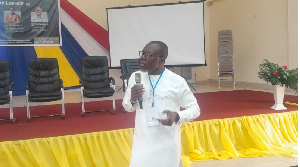 Professor Ellis Owusu Dabo is a Professor of Epidemiology and Global Health