Grace Teiko Lowor, a Ghanaian-born biomedical engineer and researcher at the University of Florida, is at the forefront of cutting-edge brain research that is redefining how neurological disorders are understood and treated.
Her pioneering work, focused on Tourette Syndrome, exemplifies how talent from Africa is shaping global scientific progress in ways that will benefit millions — from specialized hospitals in the U.S. to underserved communities in Ghana and beyond.
A proud daughter of Aburi Girls’ Senior High School and the Kwame Nkrumah University of Science and Technology in Ghana, Grace’s academic journey began with a vision: to apply biomedical engineering to solve real-world health challenges.
Today, she is delivering on that promise by developing advanced neuromodulation technologies that hold the potential to transform neurological care globally.
“At its core, my work is about decoding how the brain communicates and using that knowledge to design smarter therapies for complex conditions,” she explained. “Coming from Ghana, where access to neurological care remains limited, I’m driven by the belief that science should be inclusive — its benefits must extend across continents.”
At the University of Florida, she conducts two ambitious research projects. The first involves designing a closed-loop deep brain stimulation (DBS) system that uses real-time brain activity to manage symptoms of Tourette Syndrome intelligently. Unlike traditional DBS systems that stimulate continuously, this approach offers a personalized, adaptive treatment that could revolutionize therapy for thousands of patients.
Her second project leverages artificial intelligence to detect human tics using wearable sensors and video data — eliminating the need for subjective clinic-based evaluations. “This is a game-changer,” she said. “For Ghana and similar settings, where neurologists and diagnostic tools are scarce, a system like this could make early and accurate clinical assessment accessible in homes, schools, and local clinics.”
Grace’s research has earned national recognition in the United States. She has presented at top scientific conferences such as the Society for Neuroscience and the Biomedical Engineering Society. In 2024, she was honored as a Rising BME Scholar by the University of Illinois Chicago — a distinction awarded to only a select group of promising biomedical engineering researchers nationwide. “Recognition is encouraging,” she said, “but what truly drives me is the thought that this work can eventually help real people — children and adults living with complex conditions every day.”
Yet, her aspirations remain rooted in excellence and equity. She is a vocal advocate for research equity and mentors students from Ghana and across the world. “Scientific leadership must be global,” she said. We can’t afford to leave parts of the world behind in innovation—especially when the needs are greatest.”
Her vision is clear: to bridge engineering, neuroscience, and AI to create scalable, culturally adaptable technologies that can be implemented in high-tech hospitals and resource-limited health systems.
Grace’s work could have far-reaching consequences: improving the quality of life for patients with neurological disorders, enabling early, affordable diagnoses in low-resource regions, and driving cross-border innovations that place Ghana and Africa at the center of global medical research.
“Ultimately,” she says, “I want to help build a future where brain disorders are not just managed, but deeply understood and precisely treated — whether that’s in Florida, Accra, or anywhere in between.”
Grace Lowor stands as a beacon of what is possible when global science is powered by purpose, equity, and excellence. Her journey is not just a personal triumph — it is a national achievement for Ghana and a vital contribution to global health.
Health News of Saturday, 2 August 2025
Source: Julius Kofi Satsi, Contributor
Biomedical Engineer advances breakthrough research in neuromodulation for Tourette Syndrome
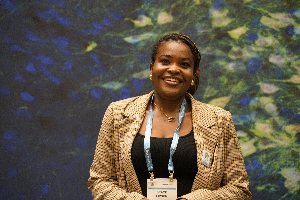 Grace Teiko Lowor is a biomedical engineer and researcher at the University of Florida






Opinions