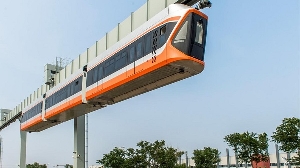
The public discourse surrounding the Accra SkyTrain project has been clouded by what the defence describes as fundamental factual mischaracterisations and an inaccurate narrative concerning the expenditure of public funds.
An examination of the project agreements, board records, financial statements and evidence presented during the trial raises important questions about the prosecution’s characterisation of the US$2 million payment involving Professor Christopher Ameyaw-Akumfi, the former Board Chairman of the Ghana Infrastructure Investment Fund (GIIF).
The defence maintains that the charges against Ameyaw-Akumfi rest on a flawed factual premise: the alleged conflation of an early-stage project development equity investment with the financing of physical railway construction.
1. The Perceived Purpose Versus the Actual Purpose of the US$2 Million Disbursement
The prosecution’s position
The particulars of offence across the counts reportedly allege that former GIIF Chief Executive Officer Solomon Asamoah and former Board Chairman Professor Christopher Ameyaw-Akumfi disbursed US$2 million to Africa Investor Holdings Limited, purportedly for the construction of an urban SkyTrain system in Accra that was never built.
According to the defence, this characterisation risks creating the impression that public funds were advanced under an engineering, procurement and construction (EPC) contract for the installation of railway tracks and the construction of stations, only for the contractors to abandon the project.
The defence disputes this interpretation, arguing that it does not accurately reflect the purpose of the transaction as documented in the project agreements and financial records.
The defence’s account of the transaction
The defence relies on documentary evidence presented before the High Court, including the Memorandum of Agreement (MoA) dated November 8, 2018, the Shareholders’ Agreement dated January 9, 2019, and GIIF’s audited financial statements for 2019 (Exhibit 21) and 2020 (Exhibit 22).
According to the defence, these documents establish the following:
Equity investment, not construction financing
The US$2 million transferred on March 4, 2019, was, according to the defence, an equity investment intended to secure a 10 per cent stake in the project development vehicle, Ai SkyTrain Consortium Holdings, incorporated in Mauritius.
The company subsequently established an operating subsidiary in Ghana, Ghana SkyTrain Limited.
The defence therefore argues that the payment was intended to finance the project's development phase rather than the immediate construction of physical railway infrastructure.
GIIF's statutory mandate
The defence further argues that the investment fell within GIIF's mandate under the Ghana Infrastructure Investment Fund Act, 2014 (Act 877), which provides the framework for mobilising and investing financial resources in infrastructure assets.
GIIF's participation in the project was structured around its proposed role as an anchor equity investor and local project development partner.
Recognition in audited financial statements
The defence also points to GIIF's audited financial statements, which it says recorded the transaction as an equity investment in a special purpose vehicle (SPV) established for project development.
The defence relies on this accounting treatment to support its position that the payment was an investment rather than a construction advance.
However, the accounting classification of a transaction does not, by itself, determine whether the transaction complied with all applicable legal and governance requirements.
Alleged absence of personal benefit or diversion
The defence further cites the cross-examination of the prosecution's principal investigator, identified as PW3, who it says acknowledged that none of the US$2 million was diverted, misapplied or appropriated for the personal benefit of Professor Ameyaw-Akumfi or another individual.
The defence considers this testimony significant to its argument that the transaction did not involve the personal appropriation of public funds.
2. The Project's Proposed Network and Transit Corridors
The Accra SkyTrain project was conceived as an elevated urban mass transit system intended to help address severe vehicular congestion across the Greater Accra Metropolitan Area.
Under the initial Memorandum of Understanding (MoU), dated February 22, 2018, between the Ministry of Railways Development (MoRD) and Africa Investor Holdings, four priority corridors were identified:
Tema/Ashaiman to Accra Central
Amasaman to Accra Central
Ayi Mensah–Madina–Adenta to Accra Central
The Kwame Nkrumah Circle Central Transit Area
A subsequent tripartite Memorandum of Agreement, dated November 8, 2018, and executed by MoRD, Africa Investor Holdings and GIIF, set out a proposed route network comprising several commuter corridors and feeder services.
The routes included:
Pink Route: Kwame Nkrumah Circle–Adenta West–Madina, and return.
Green Route: Kwame Nkrumah Circle–Pokuase, and return.
Gold Route: Pokuase–Adenta West, and return.
Blue Route: Kasoa via Accra Mall to Ashaiman, and return.
Dedicated feeder services: Shiashe Shuttle and Tema Shuttle.
Black Route: Kwame Nkrumah Circle–Downtown Commuter Loop.
These routes formed part of the proposed network intended to improve urban connectivity and provide an alternative to road-based transportation.
The inclusion of these corridors in the project documents illustrates the intended scope of the proposed system. It does not, however, establish that the project progressed to construction or that all its technical and financial requirements were satisfied.
3. Estimated Project Costs and Pre-Feasibility Metrics
The preliminary technical assessment and pre-feasibility framework developed in 2018 reportedly provided indicative cost and operational estimates for the proposed elevated transit system.
Estimated capital cost
The indicative capital expenditure was estimated at approximately US$10 million per kilometre for the elevated guideway, running tracks and modular station infrastructure.
This figure represented a preliminary estimate and would ordinarily require further technical assessment and financial validation as the project advanced.
Proposed operational characteristics
The proposed system was envisaged as an automated, high-frequency, elevated mass rapid transit network, with projected operating speeds ranging from 60 km/h to 200 km/h on designated segments.
The system was intended to reduce commuting times across the capital and improve the efficiency of urban transportation.
Projected total investment
The capital requirement for the proposed multi-phase network was estimated at approximately US$2.6 billion.
The project was envisaged under a Design, Build, Finance and Operate (DBFO) concession model, with funding expected to come predominantly from international private equity and non-recourse project finance debt.
Under the proposed structure, the intention was to minimise or avoid direct sovereign borrowing by the Government of Ghana.
These figures represented projected costs and financing assumptions at the development stage, rather than evidence that the full financing package had been secured or that construction had commenced.
4. Africa Investor Holdings' Mandate as Lead Project Developer
A central argument advanced by the defence is that Africa Investor Holdings was engaged primarily to develop and structure the project, rather than to undertake immediate physical construction of the railway system.
According to the defence, the MoU, MoA and Shareholders’ Agreement of January 2019 outlined responsibilities associated with project preparation, financing, consortium development and the eventual procurement of construction and operational partners.
These responsibilities included the following:
1. Conducting a bankable feasibility study
Africa Investor Holdings was expected to undertake or coordinate the technical, environmental, legal and financial assessments required to determine the project's viability and attract international financiers.
These activities included geotechnical investigations, route alignment assessments, environmental impact studies and financial modelling.
2. Procuring transaction advisers
The company was expected to prepare a detailed scope of work and oversee the competitive selection of an international transaction adviser to guide the project towards commercial and financial viability.
3. Structuring the consortium and preparing for EPC procurement
Its responsibilities also included developing technical specifications, preparing requests for quotation and facilitating the competitive selection of a suitable engineering, procurement and construction contractor.
The proposed consortium was expected to incorporate experienced construction and technology partners, with references in the project documents to companies such as WBHO and technology provider Aeromovel.
4. Developing operations and maintenance arrangements
The project development process was also expected to include negotiations for long-term operations and maintenance contracts, as well as the development of fare collection systems and ticketing strategies.
5. Mobilising financing and achieving financial close
Africa Investor Holdings was expected to structure a financing package capable of attracting private commercial debt, export credit support and other appropriate funding arrangements.
The objective was to achieve financial close while limiting the Government of Ghana's exposure to sovereign debt obligations.
The defence argues that the construction of the physical railway infrastructure was contingent on completing the necessary feasibility work, securing financing and reaching a final investment decision.
On this basis, it maintains that the failure to construct the railway does not, on its own, establish that the project developer failed to perform its initial contractual obligations or that the equity investment was criminally misapplied.
Whether the contractual obligations were fulfilled, and whether the payment complied with all applicable legal requirements, remain distinct questions that must be assessed against the evidence.
5. Corporate Governance, Board Authorisation and Internal Controls
The defence disputes the suggestion that Professor Ameyaw-Akumfi and Solomon Asamoah acted unilaterally in authorising the US$2 million payment.
It relies on several internal GIIF records that it says demonstrate institutional consideration and approval of the investment.
Investment Committee approval
According to the defence, GIIF's Investment Committee approved the Accra SkyTrain project development contribution on September 28, 2018, as reflected in Exhibit 24.
Board approval on October 24, 2018
The defence also relies on Minute 7.1 of GIIF's Board meeting held on October 24, 2018, identified as Exhibit 4 and reportedly recorded and certified by the Acting Board Secretary.
The minutes state:
"Following the approval by the Board, that the sum of 2 million dollars be invested in the Accra Skytrain project upon a request by Ministry of Railways with GIIF as the anchor investor in return for 10 percent stake in the Skytrain project, a memorandum of understanding was to be executed in South Africa."
The defence argues that this record supports its position that the investment received board-level approval and was not simply an independent decision by the two accused persons.
Budgetary review and Audit Committee consideration
The defence further cites the addendum to GIIF's 2019 Budget Estimates, identified as Exhibit 29A, which was submitted to the Board's Audit Committee in January 2019.
According to the defence, the document listed the SkyTrain project among the "already Board Approved Projects" and provided for a US$2 million drawdown for project development equity.
It argues that the Audit Committee did not raise an objection to the allocation.
Internal disbursement controls
GIIF's disbursement policy reportedly required joint executive sign-offs by the Chief Executive Officer and the Board Chairman for payments exceeding GH¢500,000.
The defence maintains that the transfer was processed through GIIF's Finance Department after the relevant internal approvals had been established.
It argues that the involvement of the institution's financial officers and the existence of board records support its contention that the transaction followed established internal procedures.
Auditor-General's findings
The defence also refers to paragraph 928 of the Auditor-General's report, identified as Exhibit 20.
According to its interpretation, the report did not make a finding of fraud, misappropriation or criminal dissipation of the investment but instead advised management to continue monitoring its recoverability.
The significance of this finding must be assessed within the full context of the report and the other evidence before the court.
6. Responsibility for Statutory and Parliamentary Approvals
Another issue raised by the prosecution concerns the absence of parliamentary approval under Article 181(5) of the 1992 Constitution.
The defence argues that responsibility for obtaining the necessary governmental, statutory and parliamentary approvals rested primarily with the Ministry of Railways Development, which represented the Government of Ghana in the project arrangements.
It relies on Clause 4 of the Tripartite Agreement, identified as Exhibit B, and the Concession Agreement, identified as Exhibit H, to support its interpretation of the parties' respective obligations.
According to the defence, GIIF participated as an equity investor in the project development vehicle and was not the concession-granting authority or the sector ministry responsible for securing parliamentary approval.
On this basis, the defence contends that Professor Ameyaw-Akumfi, in his capacity as a non-executive board chairman of an investment fund, should not be held criminally responsible for an approval process that fell outside his direct institutional mandate.
The legal question, however, is whether the specific duties imposed on the accused persons by law and the relevant agreements were fulfilled. That question must be distinguished from the broader issue of which public institution had responsibility for obtaining parliamentary approval.
7. The Impact of COVID-19 and Subsequent Economic Disruptions
The defence also points to developments after the execution of the project agreements in 2019 as factors that disrupted the SkyTrain project's progress.
The outbreak of the COVID-19 pandemic in early 2020 led to widespread travel restrictions, lockdowns, interruptions to international business activities and significant uncertainty in global financial markets.
According to the defence, these developments affected the project's ability to conduct field engineering surveys, hold international stakeholder consultations and secure the financing required for further development.
It also cites Ghana's subsequent economic difficulties and the Domestic Debt Exchange Programme (DDEP) as additional factors that affected the broader financing environment.
The defence characterises these developments as exceptional external circumstances that disrupted the project's timeline.
However, the extent to which these events affected the SkyTrain project, and whether they explain the project's failure to advance, must be considered alongside the project's actual progress, contractual obligations and financing arrangements.
Conclusion
The Accra SkyTrain trial raises important questions about the distinction between project development financing, the management of public investments and the criminal liability of public officials.
Professor Christopher Ameyaw-Akumfi's defence maintains that the US$2 million payment was a legitimate equity investment made in pursuit of GIIF's statutory mandate under Act 877, rather than a payment intended to finance the immediate construction of railway tracks and stations.
It relies on project agreements, board minutes, budgetary records and audited financial statements to argue that the investment was institutionally approved and properly classified.
The defence further contends that the project's failure to reach construction should not, by itself, be treated as proof that the investment was criminally misapplied, particularly given the project's proposed development structure and the economic disruptions that followed the COVID-19 pandemic.
Ultimately, the court must determine whether the evidence establishes the offences charged and whether the actions of the accused persons complied with the applicable legal and fiduciary obligations.
For Professor Ameyaw-Akumfi, the defence remains confident that an objective assessment of the evidence will demonstrate that he committed no offence.
The final determination rests with the court.
Opinions of Friday, 16 October 2026
Columnist: Todd Kwadwo Darko
SkyTrain trial: The facts, the misconceptions and the $2 million payment involving Ameyaw-Akumfi
 Todd Kwadwo Darko is the author of this article




Entertainment