Let me say something that I think needs to be said plainly: Ghana has a habit of producing excellent policy ideas and then watching them die quietly in committee rooms, not because the ideas were bad, but because the people the ideas were designed to help were never meaningfully part of the conversation.
The 24-Hour Economy has the potential to be different. But only if we make it different.
President Mahama’s decision to open an Expression of Interest registration process before finalising the implementation framework of the policy is, frankly, an unusual act of restraint for an African government in a hurry.
Rather than simply decreeing that factories must run three shifts and hoping the market complies, his administration is saying: tell us who you are, what you do, and what you need. We will design the policy around your answers.
That is an invitation that Ghanaian businesses, workers, and investors should not pass up.
Why Registration Matters
I have covered enough high-level policy processes to know that the people who show up to consultations are the people whose interests get reflected in the final framework. The people who do not show up — who assume that someone else will speak for them, or that their input is not important enough to bother — often find, when the policy is launched, that their specific concerns were not considered, and that they are now scrambling to adapt to a framework designed without them.
The EOI registration is not a guarantee of anything. It is not a contract, and it does not commit your business to operating a midnight shift tomorrow. But it does put you on the government’s radar. It signals that you are a real actor in the economy with real interests, and it entitles you to a place in the consultation process as the policy’s details are hammered out.
For small and medium enterprises in particular, this matters enormously. Large corporations have lobbyists and industry associations to advocate on their behalf. The SME owner running a logistics business in Suame, or a cold storage facility in Tema, does not. The EOI registration process is one of the few mechanisms available to ensure that the voices of smaller operators are heard at the policy design stage.
The Opportunity Before Us
Let us also be clear about what is at stake if this policy succeeds. A genuinely functional 24-Hour Economy would not just mean more factory shifts. It would mean more formal jobs, more tax revenue, more investment, and a more resilient national economy less susceptible to the external shocks that have repeatedly derailed Ghana’s growth story over the past two decades.
It would mean a Ghana where a young graduate does not have to leave for Canada or the United Kingdom because the only jobs available are daytime, minimum-wage positions in saturated sectors. It would mean a Ghana where a manufacturer in the Ashanti Region can compete globally because her factory is running at full capacity, not sitting idle from 6pm to 6am.
These are not pipe dreams. They are the documented outcomes of extended-hour economies in South Korea, Singapore, and parts of Southeast Asia that made this transition deliberately and systematically over the course of a generation. Ghana can do the same. But it requires the private sector to engage, not observe.
A Word to Those Who Are Skeptical
I understand the scepticism. Ghana has seen many flagship policies come and go. The expectation that any single initiative will fundamentally change the economic structure of the country has been repeatedly disappointed. Why should this be different?
My honest answer is that I do not know whether it will be different. But I know this: the policies that have failed in the past have almost always failed for the same reason — they were designed by technocrats for beneficiaries who were never consulted, implemented by institutions that were never adequately resourced, and evaluated by frameworks that were never agreed upon. The 24-Hour Economy, at this moment, has the chance to break that pattern.
But breaking that pattern requires participation. It requires businesses to register. It requires workers’ associations to engage. It requires investors, domestic and diaspora, to signal their interest. It requires all of us to treat this not as a government programme to be watched from a distance, but as a national project in which we are all stakeholders.
Register. Engage. Shape the Outcome
The Expression of Interest portal is open. The process is free and straightforward. If you run a business, if you lead a workers’ union, if you are an investor looking at opportunities in Ghana, or if you are simply a citizen who believes that this country deserves an economy that works around the clock, register.
Ghana’s 24-Hour Economy will either be built by Ghanaians who chose to be in the room, or it will be built around Ghanaians who chose to wait and see. The choice is yours.
Opinions of Thursday, 21 May 2026
Columnist: Kester Aburam Korankye
The 24-Hour Economy is Ghana's best chance in a generation, but only if we show up
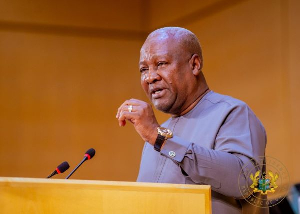 President of the Republic of Ghana, John Dramani Mahama