Sharp divisions have emerged between rival factions within the Seat of Government and the ruling National Democratic Congress (NDC) over who President John Dramani Mahama should nominate as Ghana’s next Chief Justice, as competing leaks advance the candidacies of Supreme Court Justices Gabriel Scott Pwamang and Emmanuel Yonny Kulendi.
With barely a month left before Chief Justice Paul Baffoe-Bonnie leaves office, the Presidency has yet to make an official announcement. In the absence of an official statement from the seat of government, rival camps around presidency and the NDC are pushing conflicting narratives that have complicated the President's decision.
Caught between rival power blocs at the Jubilee House and the NDC’s top brass, President Mahama now faces a choice that carries steep political consequences no matter which way he turns.
Two Camps, Two Stories, and a President in a Fix
Within 48 hours this week, competing reports exposed a split inside the administration and party hierarchy over the succession.
On Monday, sources close to the Presidency told The Law Platform that Justice Gabriel Pwamang had been settled on as the preferred nominee. Top NDC factions argue that Pwamang is capable, a longtime party friend, and the natural choice by seniority as the most senior Supreme Court Justice after the Chief Justice.
On Tuesday, a rival report emanating from the Presidency indicated that President Mahama had instead chosen Justice Emmanuel Kulendi and had already forwarded his name to the Council of State.
Sources backing the Kulendi account claim Pwamang’s role in the removal of former Chief Justice Gertrude Torkornoo weighed heavily against him. Selecting Kulendi, insiders argue, allows Mahama to insulate himself from opposition accusations of executive interference and restore public perception of judicial independence.
Baffoe-Bonnie’s absence and Pwamang’s acting role
The timing of a routine administrative arrangement has further inflamed succession talk. Before traveling abroad, Chief Justice Baffoe-Bonnie issued a circular on November 11 designating Pwamang to act as Chief Justice from November 12 to 24, noting his status as "the most senior Justice of the Supreme Court." During that window, Pwamang launched the 2026/2027 Legal Year ADR Week in Tamale, urging Ghanaians to embrace mediation as a faster, cheaper, and more confidential way to settle disputes.
Under Article 144(6) of the 1992 Constitution, the most senior Justice steps in as Acting Chief Justice when the office falls vacant until a substantive appointment is made. While having the senior-most judge cover a Chief Justice’s absence is standard protocol, and not a formal nomination, its overlap with rival faction information leaks has blurred the line between routine administration and political signaling.
Why Kulendi remains a compelling candidate
Called to the Ghana Bar in October 1994, Kulendi built a prominent career in private practice, founding Kulendi @ Law in 2002 with expertise in commercial litigation, constitutional law, banking and finance, securities, corporate law, and natural resources. Appointed directly from private practice to the Supreme Court in 2020, his supporters point to his blend of private-sector acumen and more than six years on the apex bench as ideal credentials to lead the Judiciary.
Kulendi’s record has not been without scrutiny. In 2025, a petition submitted to President Mahama alleged that Kulendi had improperly involved himself in matters linked to the ambulance procurement trial, in which his cousin, Richard Jakpa, was the third accused—though Kulendi was not presiding over the case.
From Prison to Chief Justice 'In Waiting': Profile of Justice Yonny Kulendi
The matter never reached a formal inquiry. In December 2025, the Presidency announced that Chief Justice Baffoe-Bonnie had advised that the petition disclosed no prima facie case. Because the allegations failed to meet the constitutional threshold for investigation, they were never established and do not constitute a finding of misconduct.
The Pwamang question
Called to the Bar in 1988, Pwamang practiced privately before joining the Supreme Court in June 2015 on a nomination by Mahama during his first term. As the longest-serving member of the current bench, he brings deep institutional experience, but his record also carries political baggage that critics and supporters continue to debate.
Before joining the bench, Pwamang was a member of the People's National Convention (PNC) and contested parliamentary elections, a history that routinely surfaces in debates over perceived judicial neutrality.
Pwamang chaired the five-member Article 146 committee that probed petitions against former Chief Justice Gertrude Torkornoo. Although Torkornoo challenged the committee's composition and alleged bias, the panel submitted its report to Mahama, leading to her removal on September 1, 2025. In June 2026, the ECOWAS Community Court of Justice dismissed Torkornoo’s human rights claims and rejected her arguments of bias against the panel.
Journalist Edward Adeti filed a petition in October 2026 seeking Pwamang's removal over a June 2023 Judicial Council visit and a July 2026 Supreme Court ruling. On November 10, Baffoe-Bonnie found no prima facie case, and the Presidency confirmed no action would be taken, a clearance Pwamang's allies view as removing the final hurdle to his nomination.
While none of these episodes prove Pwamang could not serve impartially, they remain central to public debate over whether his appointment would strengthen or strain confidence in the bench.
Why the Shadow of the Last Appointment Matters
The sensitivity surrounding this decision stems from lingering fallout over Mahama’s first Chief Justice appointment. Former Attorney-General Martin Amidu previously accused Baffoe-Bonnie of acting as a "surrogate" for Mahama in an alleged bid to exert executive influence over the Judiciary, a characterization the Presidency firmly rejected. Against that backdrop, Mahama’s second Chief Justice pick in two years faces heightened scrutiny from the legal fraternity, civil society, and the political opposition.
With Chief Justice Paul Baffoe-Bonnie’s departure drawing closer, the battle between supporters of Justices Gabriel Pwamang and Emmanuel Yonny Kulendi has exposed a sharp divide inside the Presidency and the NDC. Both jurists bring distinct strengths, Pwamang’s seniority and institutional memory versus Kulendi’s private-sector background and perceived insulation from recent political controversies, while each has cleared past petitions that failed to establish a prima facie case.
Until President Mahama breaks his silence, speculation and factional leaks will continue to overshadow one of the country’s most consequential judicial appointments.
“We Like the Design, Release It Now” – Ghanaians React to New Currency Notes
General News of Thursday, 26 November 2026
Source: www.ghanaweb.com
Chief Justice Race: Mahama silent as Pwamang, Kulendi camps battle behind Jubilee House doors
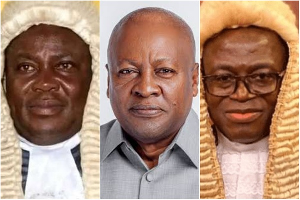 L-R: Justice Gabriel Scott Pwamang, President John Dramani Mahama and Justice Emmanuel Yonny Kulendi