Finance Minister Dr Cassiel Ato Forson is facing renewed scrutiny over the government's voluntary DDEP bond buyback, with his predecessor, Dr Mohammed Amin Adam, asking him to live up to the standard he set while in opposition.
In a Facebook post reacting to the government’s offer to buy back bonds now ahead of February's full payment date, Dr. Amin Adam questioned the Finance Minister about the rationale behind the move, when it will disadvantage DDEP bondholders, adding that Ghanaians now have the right to judge Dr. Forson by the promises he made when he stood with pensioners and bondholders in opposition.
"When he was in opposition, the Minister stood with pensioners and other bondholders. He promised to protect their interests. Now he controls the public purse, so Ghanaians have the right to judge him by the standard he set then," he said.
Dr Amin Adam threw more light on the Finance Minister's call on DDEP bondholders to come for their money through a voluntary buyback - 82 days before the bonds are due to be fully repaid on 16 February 2027.
"The Finance Minister is telling DDEP bondholders, 'Come for your money,' through a voluntary bond buyback. We should ask a simple question: how much could bondholders lose by selling early?" he said.
He warned that those who sell early will give up a higher-paying bond for a lower-paying Treasury bill.
"Anyone who waits until February will get their full money back plus the interest they were promised. Anyone who sells early gives up a bond that pays 8.35% a year. If they put the money into a 91-day Treasury bill, they will earn only about 4.5%," he said.
What bondholders stand to lose
Dr Amin Adam provided a breakdown of the potential losses bondholders will suffer if government woos them to sell early.
"For every GH¢100 of bonds: If you sell now and reinvest straight away in Treasury bills, you could end up about 86 pesewas worse off by February. If your money sits idle for a few weeks before you reinvest it, you lose more. If you don't reinvest it at all, you lose all the interest you would have earned by waiting," he said.
On the total GH¢28.58 billion in bonds, he said the collective loss could run into hundreds of millions of cedis.
"The total value of these bonds is GH¢28.58 billion. If all of it is sold back early, bondholders together could lose: About GH¢247 million, if they reinvest immediately. About GH¢346 million, if the money sits idle for four weeks first. About GH¢536 million, if the money is never reinvested before February," he said.
The former Finance Minister questioned the transparency of the buyback, particularly the price the government is offering.
"Based on what Treasury bills pay today, a GH¢100 bond is worth about GH¢100.90, not counting interest already earned. Yet the government has reportedly capped its price at GH¢100. If the government wants people to give up their February payment, why does it cap its price below what the bond is worth? And why doesn't the auction notice explain how interest already earned will be paid? Bondholders should not have to find that out on their own," he said.
He also added that the actual loss will depend on key details the government has not fully explained.
"These are estimates. The real figure depends on the price the government pays, how it handles interest already earned, and what people can earn on the money afterwards. That is why the government must give a clear explanation," he said.
Dr Amin Adam said bondholders have already sacrificed under the DDEP by accepting lower interest and waiting longer for repayment, while the government now celebrates the fall in the debt-to-GDP ratio.
"Bondholders have already paid their share. Under the DDEP, they accepted lower interest and waited longer to get their money back. They helped carry the cost of fixing the economy, and the government now celebrates the fall in the national debt to GDP ratio," he said.
"The government's side in Parliament now says the improved economy makes a new GH¢720 million presidential jet affordable. The people who made the recovery possible have every right to ask why they are now being pushed to take a deal that could leave them with less," he said.
"What bondholders need is compensation or relief for the sacrifices they made to help rebuild the economy, not a buyback that leaves them worse off," he added.
Amin Adam called on Ato Forson to publish a clear side-by-side comparison for every GH¢100 of bonds.
"The test of good faith is simple. For every GH¢100 of bonds, the government should publish two figures side by side: 1. What a bondholder gets by selling today, including interest already earned 2. What the government has promised to pay in February. Then it should explain why the deal is fair to the people who have already sacrificed," he said.
He said buybacks can be legitimate, but must not come at the expense of those who already suffered.
"I can understand that bond buybacks can be a legitimate debt-management tool, and has been used before this government, but they should not be designed at the expense of bondholders who have already suffered. A fair approach would pair liability management with meaningful relief for the investors who bore the cost of the country's recovery," he said.
"The Minister demanded this kind of accountability when he was in opposition. Bondholders are entitled to demand it from him now," he said.
Business News of Thursday, 26 November 2026
Source: www.ghanaweb.com
Amin Adam questions Ato Forson over sincerity and transparency of bond buyback offer
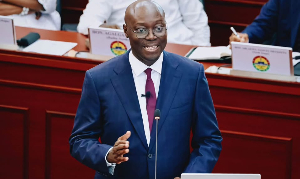 Ato Forson is the finance minister