Twenty-seven years ago, on November 25, 1999, thousands of Ghanaians took to the streets of Accra in one of the major opposition protests against the Jerry John Rawlings-led National Democratic Congress (NDC) government.
Dubbed ‘Ya bre mo’ (We are fed up with you), the demonstration brought together opposition political forces united by their dissatisfaction with the country's economic conditions, alleged corruption and what they described as the government's lack of policy direction.
The protest was organised by four political parties: the New Patriotic Party (NPP), National Reform Party (NRP), People's National Convention (PNC) and Convention People's Party (CPP). The United Ghana Movement (UGM), although not a signatory to the original agreement, also participated in the march.
What made the demonstration particularly significant was the willingness of political parties with different identities and ambitions to put aside their differences and present a united front against the governing NDC ahead of the 2000 general elections.
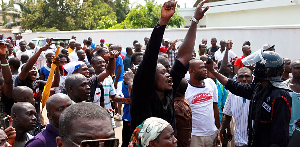
The streets of Accra became the stage for their collective expression of frustration. Thousands of demonstrators, carrying placards and singing patriotic songs, marched through parts of the capital, temporarily disrupting activities around areas including the Ministries.
Their message was unmistakable. A banner leading the procession declared: “Say no to presidential jet, say no to waste and corruption, say no to higher VAT charges, say no to petroleum charges, say no to Pricewaterhouse, say no to higher academic user fee.”
Another banner carried a contrasting message: “Say yes to accountability, say yes to better governance, say yes to probity.”
The slogans captured the central arguments of the opposition parties, which accused the Rawlings administration of mismanaging the economy and failing to respond adequately to the financial difficulties facing ordinary Ghanaians.
The protest also reflected growing discontent over the cost of living, unemployment, petroleum prices and increases in hospital and university user fees.
Ahead of the demonstration, the four organising parties had demanded greater consultation and openness in government policy formulation. They also called for the withdrawal of increases in hospital user fees and university academic charges for the 1999/2000 academic year.
Other demands included a freeze on public-sector layoffs and redundancies, particularly those associated with the divestiture of state-owned enterprises, as well as measures to stabilise petroleum prices by reducing taxes on fuel.
The parties acknowledged that their demands alone might not immediately transform the economy. However, they argued that meeting them would demonstrate that the government was sensitive to the hardship confronting the population.
The political significance of the demonstration was also reflected in the personalities who led the opposition movement. Among them were then NPP presidential candidate John Agyekum Kufuor, National Reform Party spokesman Goosie Tanoh and People's National Convention leader Dr Edward Mahama. The Convention People's Party was represented by its interim chairman, Felix Amoah.
The demonstration, which lasted nearly three hours, passed off peacefully despite earlier concerns about possible confrontations. Police officers were deployed along the designated route, but the protesters conducted themselves peacefully.
Beyond the placards, chants and political speeches, ‘Ya bre mo’ represented something bigger: an opposition determined to turn public dissatisfaction into a political force capable of challenging the NDC's continued hold on power.
It also formed part of the political atmosphere leading into the December 2000 general elections, when the NPP's John Agyekum Kufuor eventually defeated the NDC's candidate, John Evans Atta Mills, in a presidential runoff, ending the NDC's eight-year tenure under the Fourth Republic.
Looking back, the November 25, 1999 demonstration remains a notable moment in Ghana's Fourth Republic. It demonstrated how economic grievances could bring competing political parties together around a common cause and how street protests could become an important part of the country's democratic and electoral contest.
For the opposition parties, the message to the Rawlings administration was captured in just three words: ‘Ya bre mo’ — We are fed up.
EA
General News of Wednesday, 25 November 2026
Source: www.ghanaweb.com
Today in History: NPP, NRP, PNC, CPP staged ‘Ya bre mo’ demo against Rawlings' NDC government
 A file photo of protesters