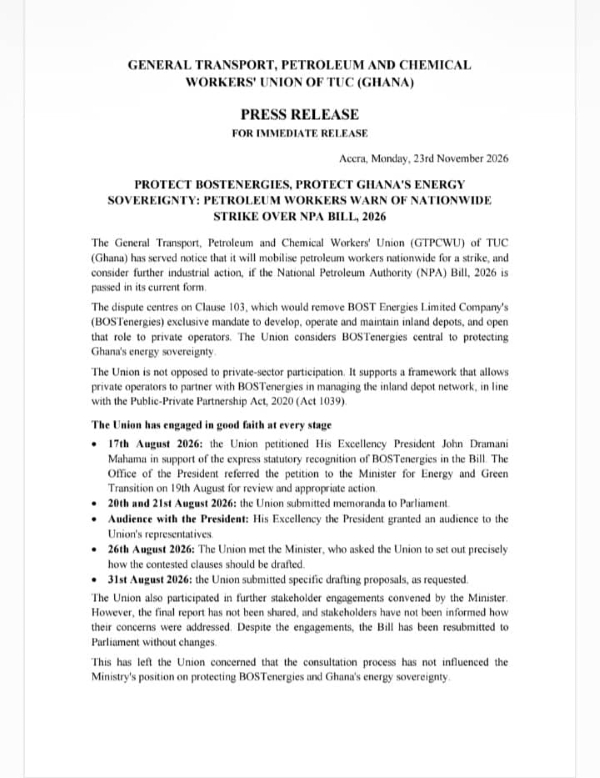
The General Transport, Petroleum and Chemical Workers’ Union (GTPCWU) of TUC (Ghana) has served notice that it will mobilise petroleum workers nationwide for a strike if the National Petroleum Authority (NPA) Bill, 2026, is passed in its current form.
In a press release issued in Accra on Monday, November 23, 2026, the Union said the dispute centres on Clause 103, which would strip BOST Energies Limited of its exclusive mandate to develop, operate and maintain inland depots and open the role to private operators. The Union considers BOST Energies central to protecting Ghana’s energy sovereignty.
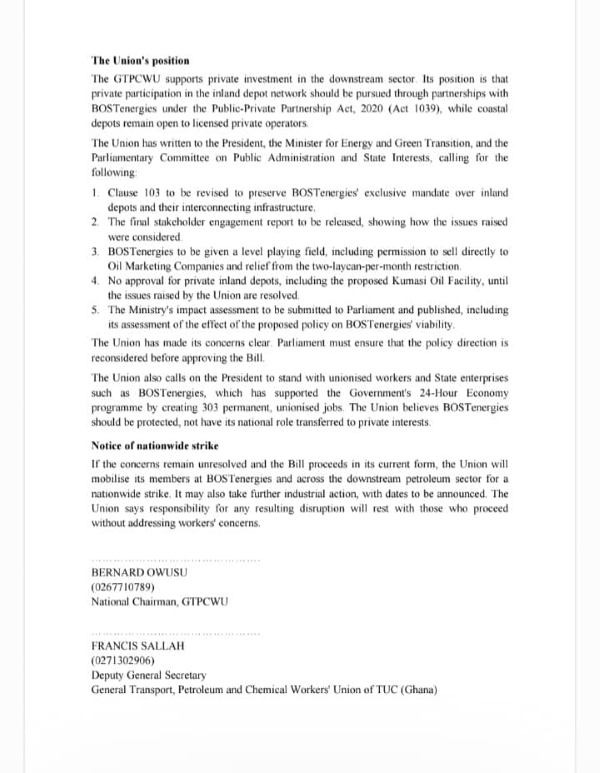
“The Union is not opposed to private-sector participation. It supports a framework that allows private operators to partner with BOST Energies in managing the inland depot network, in line with the Public-Private Partnership Act, 2020 (Act 1039),” the statement said.
The GTPCWU said it had engaged in good faith at every stage, including petitioning President John Dramani Mahama in August, submitting memoranda to Parliament, meeting the Minister for Energy and Green Transition, and providing specific drafting proposals. Despite further stakeholder engagements, the Bill was resubmitted to Parliament without changes addressing its concerns.
NPA Bill 2026 could weaken BOST, lead to sale of its assets to private businesses – AFAG
“This has left the Union concerned that the consultation process has not influenced the Ministry’s position on protecting BOST Energies and Ghana’s energy sovereignty,” it stated.
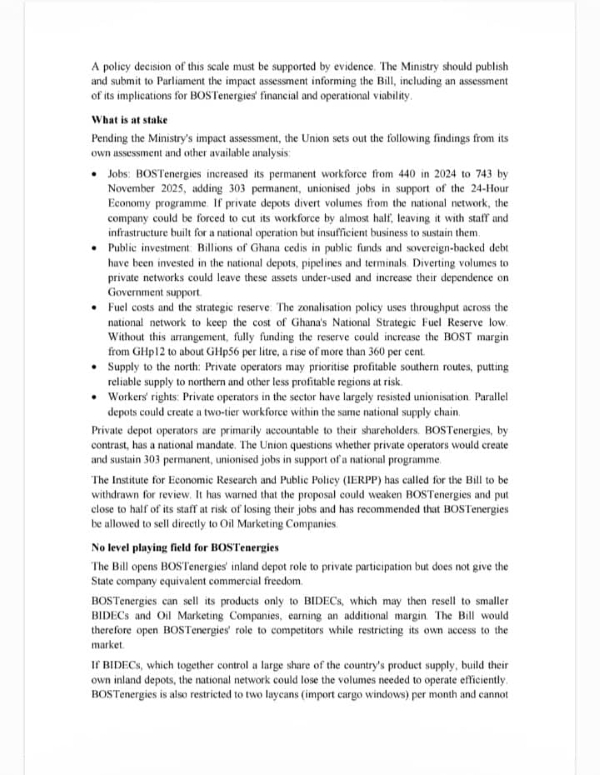
The Union warned of significant risks if volumes are diverted from the national network. BOST Energies increased its permanent workforce from 440 in 2024 to 743 by November 2025, adding 303 permanent, unionised jobs in support of the 24-Hour Economy programme.
Private competition could force the company to cut its workforce by almost half. It also pointed to billions of cedis in public funds and sovereign-backed debt invested in national depots, pipelines and terminals, higher fuel costs for the strategic reserve, risks to supply in northern Ghana, and threats to workers’ rights.
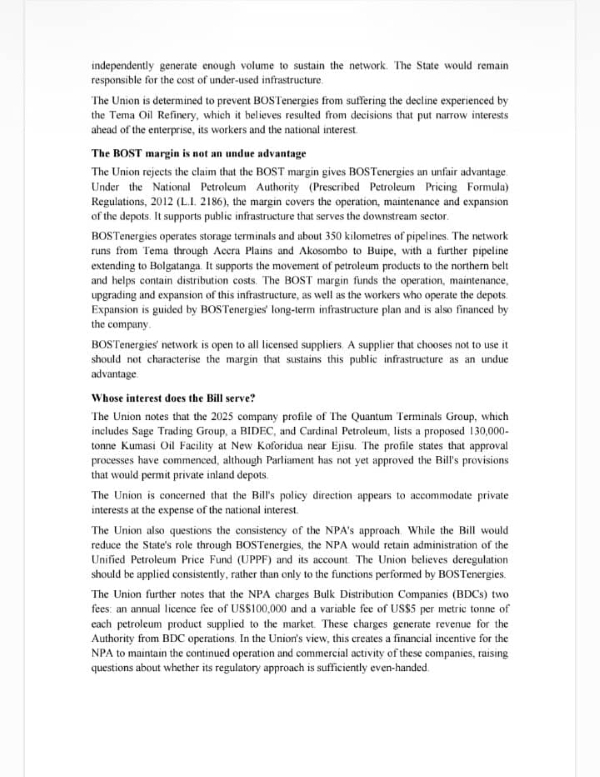
Private depot operators, the Union noted, are primarily accountable to their shareholders, while BOST Energies has a national mandate. It further argued that the Bill does not give the state company equivalent commercial freedom, restricting it to selling only to BIDECs while opening its role to competitors.
The Union has called for Clause 103 to be revised to preserve BOST Energies’ exclusive mandate over inland depots, the release of the final stakeholder engagement report, a level playing field including permission for BOST Energies to sell directly to Oil Marketing Companies, no approval for private inland depots until the issues are resolved, and the publication of the Ministry’s impact assessment.
“If the concerns remain unresolved and the Bill proceeds in its current form, the Union will mobilise its members at BOST Energies and across the downstream petroleum sector for a nationwide strike. It may also take further industrial action, with dates to be announced,” the statement warned.
“The Union says responsibility for any resulting disruption will rest with those who proceed without addressing workers’ concerns,” it added.
Read the statement below
NA/VPO
General News of Monday, 23 November 2026
Source: www.ghanaweb.com
Nationwide petroleum strike looms as union rejects 2026 NPA Bill
 File photo of a fuel pump