Policy think tank, the Africa Policy Lens says the 2027 Budget and the New Economy policy document give different accounts of how the Western Corridor Railway from Takoradi to Nyinahin will be financed.
In a post budget analysis statement, the APL noted that beneath the New Economy line, Appendix 3C shows two sources: petroleum revenue (ABFA) of GH¢8.7 billion and mineral royalties of GH¢10.3 billion, totalling GH¢18.9 billion, or 63 percent of the total.
The Minister of Finance, during his presentation, told Parliament that in 2027 and 2028 these revenues would be dedicated “solely” to the Western Corridor Railway, adding that: “we will not borrow to build this railway.”
The statement said feasibility, engineering design, and costing are described as “ongoing”.
The policy document, however, states: “Beginning in 2027, Government will secure and deploy concessional financing from development partners” to complete the same railway by the end of 2030.
“Concessional financing is still borrowing,” Africa Policy Lens said.
The document also places the railway inside a US$1.5 billion minerals pillar that must cover four years and several processing plants, while the Budget’s two revenue lines come to about US$1.6 billion in 2027 alone, according to the analysis.
The transport ministry’s own “Railways Development” line is GH¢174 million, the statement said.
“If the railway takes the GH¢18.9 billion, roughly GH¢11 billion remains in 2027 for everything else in the programme. Ghanaians deserve one answer: is the railway to be built with our own money, with loans, or with both?” the statement said.
Other Inconsistencies Cited
The statement also cited differences in figures and timelines for other projects.
“The 1,200-megawatt state power plant due to begin in 2026 has been resized to 1,450 megawatts; the Budget says construction starts this December, while the policy document schedules it for 2027,” it said.
“The three garment factories remain at the feasibility stage. The US$500 million oil-palm financing is yet to reach Parliament. The Accra–Kumasi Expressway money is ‘in the safe custody of the Bank of Ghana’ while construction awaits,” the statement added.
On the Budget figures, the group said: “The budget puts 2027 capital expenditure at GH¢98.4 billion; the appendix says GH¢100.4 billion. The Big Push is given as GH¢27.8 billion, GH¢28 billion and GH¢29.8 billion in different paragraphs.”
Africa Policy Lens asked Parliament to seek “one statement on the railway: its cost, whether it is financed from revenue or from loans, and a separate, visible budget line” and “clarity on borrowing: whether the loans cited in the policy document sit inside the US$10 billion or on top of it.”
It also called for quarterly published reports of commitments and releases by pillar, and “one reconciled set of capital expenditure figures across the speech and the appendices.”
The Budget promises that “every project will undergo rigorous appraisal and value-for-money assessment” and that “all commitments will be budgeted, authorised and transparently reported,” the statement noted.
Business News of Tuesday, 17 November 2026
Source: www.ghanaweb.com
2027 Budget: APL reveals contradictions over Western Corridor railway financing, other projects
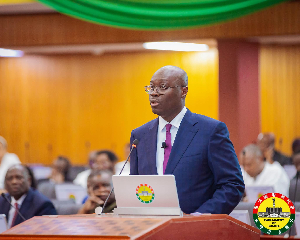 Minister of Finance, Cassiel Ato Forson presenting the budget in Parliament