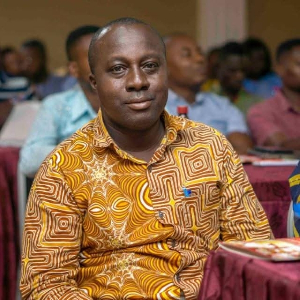
New Patriotic Party (NPP) stalwart Gabby Asare Otchere-Darko has recounted his grandfather, Nana Ofori Atta I's, role in shaping traditional authority and governance in the Gold Coast during colonial rule.
In a Facebook post on October 29, 2026, he said Nana Ofori Atta I, who ruled Akyem Abuakwa from 1912 to 1943, was among the traditional rulers who helped integrate traditional authority into the colonial system of governance.
“My grandfather, Nana Ofori Atta I, who reigned Akyem Abuakwa from 1912 to 1943, was a major actor of that system of compromise,” he wrote.
Gabby said his grandfather encouraged his friend, Governor Frederick Guggisberg, to include traditional authorities in a structured system of modern governance.
He added that Nana Ofori Atta I was one of the first two traditional rulers to join the Gold Coast Legislative Council in 1916, alongside E Mate Kole, the ruler of Manya Krobo.
He also said his grandfather led a committee of chiefs that drafted the Native Administration Ordinance of 1927, which he later introduced in the Legislative Council.
Gabby linked his grandfather’s role in governance to the struggle for independence, noting that his grandfather’s younger brother, Dr Joseph Boakye Danquah, co-founded the United Gold Coast Convention (UGCC) with Paa Grant.
The UGCC was the Gold Coast’s first political movement dedicated to achieving independence. Its leaders included R.S. Blay, Francis Awoonor-Williams, Edward Akufo-Addo, William Ofori-Atta, Emmanuel Obetsebi-Lamptey, Ebenezer Ako-Adjei and Kwame Nkrumah, who served as its general secretary.
Gabby said traditional rulers across Africa made several concessions during colonial rule to protect their people and institutions, sometimes under pressure or coercion.
He added that African countries largely retained the colonial boundaries after independence, even where they divided communities and the lands of the same people.
“When independence came, the new African states largely retained the inherited boundaries, even where those lines divided the lands of the same peoples. That was the level of indignation our Kings and Queens had to endure for the sake of peace and development,” he stated.
He also recalled the formation of the Organisation of African Unity (OAU) in 1963 and the decision by African leaders in 1964 to respect the borders inherited from colonial rule to prevent conflict.
According to Gabby, traditional rulers were also involved in discussions about African unity, citing Ethiopian Emperor Haile Selassie I, Burundi’s King Mwami Mwambutsa IV and Libya’s Crown Prince Hasan Rida, who represented King Idris I.
He quoted King Mwambutsa as describing unity as “a living entity which requires only to be translated on to the institutional plane.”
Gabby said Ghana’s first President, Kwame Nkrumah, renewed the call for African unity at the OAU summit in Accra in 1965, where he pushed for an African union government.
However, he argued that the effort failed partly because African leaders did not fully recognise the role traditional rulers could play in bringing different peoples together.
“Our Pan-African leaders failed then, in my view, partly because they ignored or had forgotten the power of our traditional leaders in making our peoples part of a broader union of diverse states,” he said.
Read his post below:
Inside Ghana’s First 950,000-Barrel Sankofa Oil Shipment | Exclusive Tour
“We Can’t Adapt to This New Road Technology” | Ghanaians React to TRAFFITECH-GH
General News of Saturday, 31 October 2026
Source: www.ghanaweb.com
Gabby recounts grandfather Nana Ofori Atta I’s role in Gold Coast governance
 Gabby Asare Otchere-Darko is a stalwart New Patriotic Party




Entertainment