Ghana has proposed the establishment of a Ghana-China Market Access Council to help local exporters take advantage of China’s zero-tariff initiative for African goods, as authorities seek to narrow the country’s widening trade imbalance with the Asian economic powerhouse.
The proposed Council was introduced by Eric Nii Amu Okotokata Dodoo-Amoo, Head of the China Desk at the Ministry of Finance, during a high-level forum at the African Continental Free Trade Area (AfCFTA) Secretariat in Accra on October 15, 2026.
The platform is intended to translate China’s duty-free market access into measurable export growth by addressing supply constraints, improving regulatory compliance and connecting Ghanaian producers to large-scale Chinese buyers.
China announced its zero-tariff initiative in May 2026, offering duty-free access across all tariff lines for eligible African exports. However, Ghanaian businesses face challenges that could prevent them from fully exploiting the opportunity, including limited production capacity, high transport costs, inadequate cold-chain infrastructure and difficulties meeting Chinese import regulations.
The proposed Council would bring together the Ministry of Finance, commercial banks, trade regulators, logistics providers, business associations and research organisations, including the Africa-China Centre for Policy and Advisory, to coordinate export development and eliminate duplication among agencies.
It would also help small-scale producers aggregate output, share logistics and meet the volume requirements of large Chinese orders.
A key priority would be ensuring that Ghanaian products comply with Chinese sanitary and phytosanitary requirements, packaging standards, labelling rules and other customs procedures. Agencies such as the Ghana Export Promotion Authority and the Food and Drugs Authority are expected to play important roles in guiding exporters through the regulatory process.
The framework also envisages coordination with a proposed Ghana-China Zero-Tariff Fund to provide trade finance, equipment leasing and liquidity for contract farming, particularly for small-scale processors seeking to expand production.
Through business networks, including those associated with CEIBS Africa, the Council would serve as a market-information hub, linking Ghanaian suppliers with vetted distributors in major Chinese cities.
The initiative comes amid concerns about the widening imbalance in bilateral trade. Ghana-China trade reached US$14.12 billion in 2025, comprising US$11.45 billion in Ghanaian imports from China and US$2.67 billion in exports to the Asian country.
The imbalance has become more pressing in 2026. Ghana Statistical Service data cited in the proposal show that the country’s merchandise trade surplus fell from US$4.3 billion in the first quarter to US$1.3 billion in the second quarter.
Between the two quarters, imports rose 47.5 percent to GH¢94.7 billion, while export earnings declined 1.6 percent to GH¢108.5 billion.
The proposed Council is expected to support the export of higher-value products, including processed cocoa, cocoa butter, confectionery, cashew products, shea butter and packaged cosmetics, rather than relying predominantly on raw commodities.
Stakeholders are seeking an early operational start, given the time-bound nature of China’s market-access arrangements for countries such as Ghana.
The government hopes the initiative will help local businesses convert duty-free access into increased export earnings, stronger domestic processing and a more balanced trading relationship with China.
Business News of Tuesday, 27 October 2026
Source: businesspostonline.com
Ghana proposes China Market Access Council to boost exports
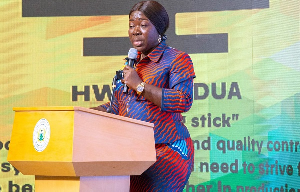 Elizabeth Ofosu-Adjare is the Minister for Trade, Agribusiness and Industry