Former Junior Common Room (JCR) President of the Commonwealth Hall of the University of Ghana, Benjamin Akyena Brantuo, has called on the university to reverse its decision to dismiss undergraduate students who obtained a Cumulative Grade Point Average (CGPA) below 1.00 at the end of the 2025/2026 academic year.
In a statement issued on Friday, October 23, 2026, Brantuo argued that the decision undermines students’ right to education and called on the university to reconsider its approach to students who struggle academically.
"A university does not exist merely to train students who are already academically accomplished. It should also provide opportunities for learning, growth and transformation. It is a place where people are equipped to become something more than they were when they arrived.
"As Ghana's premier university, the University of Ghana is one of the institutions upon which the nation depends to prepare young people for leadership and responsible citizenship", he said.
He urged management to reverse the decision immediately and remove the provision underpinning it from the University Regulations for Junior Members.
“Alternatively, the management should resign, since it has failed to understand and carry out its mandate in the spirit of the 1992 Constitution of Ghana regarding education,” he stated.
The University of Ghana has directed undergraduate students whose CGPA fell below 1.00 at the end of the 2025/2026 academic year to withdraw from their programmes.
According to the university’s Academic Affairs Directorate, the directive is in accordance with Section 9.26 of the University Regulations for Junior Members (2017).
However, Brantuo questioned whether the university had adequately considered the circumstances that might have contributed to the affected students’ poor academic performance.
“The story, culled from a publication on the University’s Facebook page, does not explain how this decision serves the best interests of the University, Ghana or the affected students,” he said.
He argued that examination failure was only one part of the academic process and that the university should also examine the quality of teaching, the effectiveness of lecturers’ methods, access to learning materials and the ratio of students to lecturers.
He further questioned whether the affected students had been interviewed to establish the challenges they faced before the decision was taken.
“What if a student was dealing with trauma resulting from bereavement? What if a student lacked the resources to obtain adequate food and maintain the physical and mental well-being necessary to cope with the demands of academic life?” he asked.
Brantuo maintained that even if the students were solely responsible for their poor academic performance, that should not automatically deprive them of the opportunity to continue their education.
“Even if we were to conclude that the students themselves were solely responsible for failing their continuous assessments and examinations, that would still not justify denying a Ghanaian the opportunity to pursue an education, especially when they can afford it,” he stated.
He cited Article 25(1) of the 1992 Constitution, which recognises the right of all persons to equal educational opportunities and facilities.
The provision states, in part, that “higher education shall be made equally accessible to all, on the basis of capacity, by every appropriate means, and in particular, by the progressive introduction of free education”.
Brantuo argued that using a CGPA threshold to dismiss students ran contrary to the spirit of that constitutional provision.
“Using a CGPA requirement of above 1.00 to deny people educational opportunities is a denial of their right to education and, in my view, runs contrary to the spirit of the Constitution,” he said.
He also questioned the university’s full-fee-paying policy, which allows students to gain admission under arrangements that do not require government subsidy.
According to him, some students who entered university with comparatively weak grades had subsequently succeeded academically when given the opportunity.
“Today in Ghana we have medical doctors who were admitted to do biological science with aggregate six of their Senior Secondary School Certificate results and those who came on the full fee-paying route with terrible grades but are also successful medical doctors,” he stated.
University of Ghana orders students with CGPA below 1.00 to withdraw
He questioned why the university would admit students with comparatively weak entry grades but be quick to dismiss those who encountered academic difficulties after admission.
“If the University can recognise that students with comparatively weak entry grades may succeed when given a chance, why should it be so quick to abandon students who struggle after admission?” he asked.
Brantuo said the university should first examine the factors responsible for the students’ difficulties and consider whether additional support or opportunities to improve could help them progress academically.
He maintained that the purpose of higher education should extend beyond training students who are already academically accomplished.
“A university does not exist merely to train students who are already academically accomplished. It should also provide opportunities for learning, growth and transformation,” he stated.
Brantuo also argued that education offered benefits beyond academic qualifications, including personal development, discipline, social interaction and opportunities for students to discover their abilities.
JKB/VPO
Emotional Moment as Piesie Esther Grabs the Mic at Mabel Intuah’s Funeral
General News of Friday, 23 October 2026
Source: www.ghanaweb.com
Former JCR president reacts to dismissal of UG students over low CGPAs
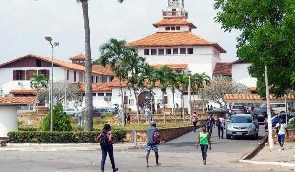 The University of Ghana had ordered students with CGPA below 1.00 to withdraw








Opinions