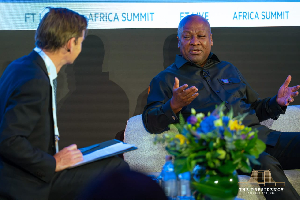
President John Dramani Mahama has set 2030 as Ghana’s target date to end the export of raw mineral ores, as the government seeks to expand local processing, create jobs and retain more value from the country’s natural resources.
Speaking during a panel discussion at the 2026 Financial Times Africa Summit on Wednesday, October 21, 2026, he said Ghana could no longer depend on exporting raw materials while importing finished products.
President Mahama advocates domestic financing to reduce Africa’s aid dependence
He argued that the country needed to develop industries capable of processing its resources before they reached international markets.
“We cannot continue forever to be the exporter of raw materials to the rest of the world and consumers of finished products,” President Mahama said.
“We must bring part of that processing and value addition into Africa to create jobs for our young people,” he added.
The President said the 2030 deadline would be implemented in phases, depending on the mineral involved and the investments required to establish processing facilities.
He explained that the policy was intended to boost local industrial activity and create more employment opportunities, particularly for young people entering the job market.
President Mahama cited Ghana’s cocoa industry as one of the sectors in which the government intends to increase domestic processing. He said the country had traditionally exported raw cocoa beans for processing abroad but was seeking to change that arrangement by ensuring that at least half of its annual cocoa production was processed locally.
“I've come out with a policy that we're going to start with at least 50% of our cocoa beans to be processed locally,” he said.
He continued, “And so 50% of any year's production is only what will be available on the international market.”
He said the policy would expand cocoa-processing activities in Ghana and create jobs while allowing the country to benefit from more stages of the value chain rather than relying mainly on exports of unprocessed beans.
The President also identified bauxite as a mineral with significant potential for local value addition.
He explained that Ghana currently exports raw bauxite, imports alumina and operates a smelter that processes alumina into aluminium for export.
However, the country does not have an alumina refinery, which he described as the missing link in the production chain.
“The only missing link is that we don't have an alumina refinery,” President Mahama said, inviting investors to partner with Ghana to establish the facility and benefit from the additional value generated within the aluminium industry.
He added that the government was also exploring opportunities to expand the downstream jewellery industry, including jewellery manufacturing for export, as part of efforts to retain more value from gold.
President Mahama said the broader objective was to move beyond exporting commodities in their raw form and develop industries that could support local production and employment.
Addressing concerns about investment security and property rights, the President urged international investors not to overlook opportunities on the continent because of reservations about doing business in Africa.
“Well, it's to their own disadvantage if you are still skittish about Africa,” he said, adding that Ghana welcomed investors from different parts of the world.
President Mahama said Ghana’s investment policy was not about choosing between competing international partners but ensuring that investments delivered fair returns to both investors and the country.
“We are friends to all and enemies to none,” he said, reaffirming Ghana’s non-alignment policy and its openness to investors from across the world.
ANAS/MA
2026 FT Africa Summit | President Mahama on headwinds that should shape Africa’s economic future
Business News of Thursday, 22 October 2026
Source: www.ghanaweb.com