By October 21, the story of Western Togoland remains a reminder of how colonial history, competing interpretations of self-determination and questions of national identity can converge into a serious security challenge.
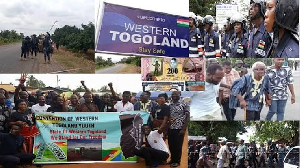
The words “Welcome to Western Togoland” appeared on makeshift signs in Ghana’s Volta Region, but the message carried a far greater significance than a simple territorial declaration. For separatists seeking independence from Ghana, it represented a claim to a state of their own. For Ghanaian authorities, it was a challenge to the country’s territorial integrity that would eventually be accompanied by armed attacks, roadblocks, arrests and bloodshed.
The confrontation that erupted in September 2020 brought renewed national attention to the Western Togoland question, an issue rooted in the colonial history of the territory and decades of unsuccessful attempts by separatist groups to establish an independent state.
As the crisis intensified, the debate moved beyond historical grievances and political declarations. Armed men attacked security installations, weapons were reportedly seized, prisoners were freed and transport operations came under attack. The events raised urgent questions about national security, the legacy of colonial boundaries and the limits of separatist movements operating within an established state.
The colonial history behind the Western Togoland question
The roots of the dispute stretch back to the First World War, when British and French forces took control of German Togoland in 1914. The territory was subsequently divided, with the western portion placed under British administration and the eastern portion under French control.
After the Second World War, British Togoland became a United Nations Trust Territory administered by Britain. Its future became a subject of international deliberation as the Gold Coast moved towards independence.
On May 9, 1956, residents of British Togoland participated in a United Nations-supervised plebiscite to decide whether the territory should join the soon-to-be-independent Gold Coast or remain under United Nations trusteeship pending a decision on the future of French Togoland.
The official figures show that 93,095 people voted for integration with the Gold Coast, representing approximately 58 per cent of valid votes, while 67,492 voted to remain under trusteeship, representing about 42 per cent. The total number of valid votes was 160,587, with turnout recorded at approximately 82.7 per cent. The United Nations subsequently approved the union of British Togoland with the independent Gold Coast.
Ghana attained independence on March 6, 1957, and the former British-administered territory became part of the new country.
However, the outcome did not end all opposition to the arrangement. Some people and political movements continued to question the integration of the territory, providing the historical foundation upon which later separatist campaigns would build.
For those advocating independence, the issue was not simply about drawing a new boundary. It was also about how the territory's past should be interpreted and whether its people had been adequately represented in decisions concerning their political future.
For Ghana, however, the territory forms part of its recognised national territory, and separatist declarations do not, in themselves, establish a sovereign state.
From historical grievances to armed confrontation
The Western Togoland question became particularly prominent in September 2020, when separatist activities escalated into violent confrontations in parts of the Volta Region.
One of the groups associated with the violence was the Western Togoland Restoration Front (WTRF). According to reports at the time, its members attacked two police stations, seized firearms and ammunition, freed inmates and injured police officers.
The stolen weapons reportedly included 15 AK-47 assault rifles, alongside other firearms. Three police officers were also reportedly held hostage before security personnel rescued them.
A subsequent security operation resulted in the arrest of 31 suspected members of the group following a shootout in which one separatist was killed and three others were injured, according to the account of events.
The WTRF subsequently issued a statement asserting sovereignty over the territory and demanding that Ghanaian security forces withdraw. The group also called for negotiations on independence, with the United Nations serving as a mediator.
In its declaration, the group sought to exercise control over political and media activities within the territory it claimed as a new state.
“All political activities within the new state are banned with immediate effect,” the statement read.
The declaration further sought to designate certain radio stations as Western Togoland state radio stations and instructed media houses operating within the claimed territory to focus predominantly on Western Togoland-related issues.
Such pronouncements represented an attempt by the separatists to project the image of a functioning state. But declarations of sovereignty, the adoption of state-like institutions and the use of force do not, by themselves, confer international recognition or establish lawful statehood.
The developments nevertheless demonstrated how the separatist campaign had moved beyond public advocacy and historical argument into a confrontation with Ghana's security institutions.
The attack on the STC yard
The crisis took another troubling turn on September 29, 2020, when armed men reportedly attacked a State Transport Corporation (STC) bus yard in Ho, the Volta Regional capital.
At least a dozen armed assailants were reported to have stormed the facility, set one bus ablaze and damaged another. Drivers were also reportedly beaten while being held at gunpoint.
The attack reinforced concerns that the separatist violence could extend beyond security installations and directly affect transport services, workers and ordinary residents.
Police subsequently arrested 30 suspected separatists following another gunbattle, during which one civilian was reportedly killed.
The incident illustrated the potential consequences of an increasingly violent territorial dispute. Public transport infrastructure, police facilities and civilian livelihoods had become vulnerable to a confrontation driven by competing claims over national identity and sovereignty.
It also raised questions about the preparedness of security agencies to respond to armed groups seeking to undermine state authority in border communities.
A second group distances itself from the violence
As the violence attracted attention, the Homeland Study Group Foundation (HSGF), another organisation associated with the Western Togoland independence campaign, publicly denied involvement in the attack on the STC facility.
In a statement posted on Facebook, the group said it had no role in the destruction of the buses.
“The HSGF and all its various chapters and branches had no hands in the burning of the vehicles of the STC in Ho last night,” the statement said.
The group maintained that its campaign was intended to pursue what it described as the rights of the people it represented without violence.
“The campaign for our rights of citizenship, which is being questioned continuously by some section of Ghanaians, will be without violence,” it added.
The statement exposed an important distinction within the broader separatist movement: although different organisations shared demands associated with Western Togoland, they did not necessarily accept responsibility for the same tactics or incidents.
The HSGF had previously attracted the attention of Ghanaian authorities. In 2017, seven of its members were arrested after an attempted declaration of independence and charged with treason. In 2019, police arrested another 81 members in connection with plans for a protest. According to the account of those events, most of the charges were eventually dropped.
The group's denial of involvement in the 2020 attacks did not settle the underlying question of independence. Instead, it underscored the challenge facing authorities in distinguishing between political advocacy, unlawful activity and participation in violent operations.
Bawumia's blunt response
The Ghanaian government's position was firmly expressed by then Former Vice-President Mahamudu Bawumia, who rejected the separatists' claim that Western Togoland existed as an independent state.
Speaking on Asempa FM in Accra in late September 2020, Bawumia dismissed the claim and ruled out negotiations with the separatists.
“The area today they call Western Togoland must be a figment of their imagination,” he said.
“It does not exist. There is no legal basis for their claims. No negotiations! With those criminals?”
His remarks reflected the government's determination to defend Ghana's territorial integrity and its refusal to treat the separatists' unilateral declaration as a legitimate basis for negotiations on independence.
The government's position was that the activities constituted a matter of law enforcement and national security rather than a dispute between two recognised states.
For separatist advocates, however, the issue was tied to historical interpretations of the 1956 plebiscite and the right of a people to determine their political future.
The disagreement revealed the gulf between the two positions: the government maintained that the territory was an integral part of Ghana, while separatist groups sought recognition of a separate political entity.
The international dimension
The Western Togoland question also attracted attention beyond Ghana's borders.
Western Togoland was associated with the Unrepresented Nations & Peoples Organization (UNPO), an international organisation that represents communities and peoples lacking adequate representation in international institutions.
In a statement issued in late September 2020, the organisation called on Ghana to re-engage with the HSGF.
Its position centred on the distinction between advocating self-determination and automatically acquiring a right to independent statehood.
“While the right to self-determination does not grant an automatic right to independent statehood of any peoples who seek it, the right to believe in and seek independent statehood through non-violent and lawful means is protected under international human rights law,” the organisation said.
It also warned against the possible consequences of suppressing peaceful political beliefs.
“Persecuting that freely held belief serves no practical purpose and can only lead to increased resentment and instability, as we appear to be witnessing in Western Togoland today.”
The statement did not establish Western Togoland as an independent country. Rather, it advanced an argument for engagement with those advocating independence through peaceful and lawful means.
The distinction is significant. The right to express political views or advocate self-determination does not automatically translate into a right to unilateral secession. Equally, the existence of a security threat does not eliminate the need to distinguish peaceful political expression from violence and other criminal conduct.
The unresolved question of identity and sovereignty
The events of September 2020 exposed the risks of allowing a long-running historical dispute to escalate into armed confrontation.
The seizure of weapons, attacks on police facilities, hostage-taking, the burning of buses and arrests of suspected separatists transformed the Western Togoland question from a largely political and historical debate into an immediate security concern.
Yet the underlying disagreement cannot be understood solely through the lens of law enforcement. Its history involves colonial administration, a United Nations-supervised plebiscite, competing political aspirations and enduring disagreements over how the past should shape the present.
For Ghana, the issue concerns the protection of its territorial integrity and the safety of its citizens. For those campaigning for Western Togoland's independence, it concerns their interpretation of history, political representation and self-determination.
The challenge lies in addressing legitimate political grievances through lawful channels without permitting violence to threaten lives, public infrastructure and national stability.
As Ghana reflects on the Western Togoland crisis, the events serve as a reminder that historical disputes can have consequences far beyond the archives in which their origins are recorded. When questions of identity and sovereignty are left unresolved in the public imagination, they can become powerful tools for mobilisation.
But history alone does not determine the future of a territory. Political decisions, legal processes, public dialogue and the choices made by successive generations also shape the path ahead.
The Western Togoland crisis remains a compelling chapter in Ghana's post-independence history: a story of colonial legacies, competing claims, state authority and the dangerous point at which a campaign for independence becomes a violent confrontation.
Guns and Drugs: Dr Adam Bonaa Warns of Growing Security Threat to Ghana
EA
General News of Wednesday, 21 October 2026
Source: www.ghanaweb.com
Today in History: A country within a country; the Western Togoland story
 How Western Togoland Became a Security Threat to Ghana






Opinions