Ghana has called for more direct access to climate finance and predictable funding to prepare development projects, with the Ministry of Finance stressing that local institutions need practical experience to build their capacity to manage investments.
Chief Economic Officer at the Ministry of Finance, Richard Addo, said national institutions must be given the opportunity to lead projects instead of relying on external experts to handle key aspects of the process.
Gov’t constructing 1,000km of roads to support agriculture – Dumelo
Speaking at the National Deal Teams and Platforms technical event on the sidelines of the 2026 IMF-World Bank Annual Meetings in Bangkok, Thailand, on Friday, October 16, 2026, he said Ghana needed to translate its development plans into projects capable of attracting funding and delivering results.
“Countries build their capacity best when they are given the opportunity to lead and deliver real investments,” Addo said.
He explained that Ghana’s Reset Agenda places economic growth, job creation and economic transformation at the centre of its development plans. However, he said turning these goals intoA completed projects remained a major challenge.
“Our priority is to move beyond identifying development needs and focus on preparing projects that are ready for investment and can be delivered on a larger scale,” he said.
Addo also called for adequate funding for the Ministry of Finance’s Project Preparation Fund to support the development of investment-ready projects.
He said predictable financing would help Ghana attract support from development finance institutions, private investors and bilateral partners.
He identified the Ghana Infrastructure Investment Fund and Development Bank Ghana as important institutions that could help structure projects and attract long-term and green financing.
Addo said Ghana faced a challenge in which local institutions were sometimes considered unprepared to manage climate finance but were not given enough opportunities to gain the experience needed to qualify for direct access.
“We cannot expect national institutions to build a strong track record if they are not given the chance to manage and deliver projects,” he said.
He stressed that international experts should support local institutions rather than take over their responsibilities, adding that such partnerships should include clear plans for transferring skills and strengthening local capacity.
Addo also backed the use of Country Platforms to bring the government, investors and development partners together to support national priorities.
He said the approach could help coordinate funding for projects in water, health and climate resilience under the Vulnerability-to-Viability Compact.
“The measure of success should not be only how much financing we mobilise, but also how much stronger our national institutions become in the process,” he said.
He added that Ghana’s revised Climate Prosperity Plan provided a framework for aligning investment and financing with the country’s development goals.
“The most effective way to build capacity is through delivery, not through perpetual preparation,” Addo said, urging development partners to give national institutions greater responsibility for implementing projects.
ANAS/MA
How a Visit to GHACEM Inspired Ibrahim Mahama to Build Dzata Cement
Business News of Saturday, 17 October 2026
Source: www.ghanaweb.com
Ghana calls for direct access to climate finance
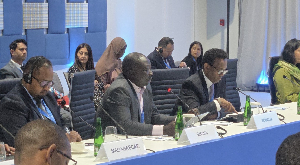 Richard Addo is the Chief Economic Officer at the Ministry of Finance