Okomfo Anokye remains one of the most revered figures in the history of the Ashanti Kingdom.
He is remembered for his spiritual influence, wisdom and role in the formation of one of Ghana’s most powerful traditional states.
Working alongside Asantehene Osei Tutu I, Okomfo Anokye is credited with helping unite the Asante clans into a formidable kingdom in the late 17th century.
Here is why the Asantehene's Golden Stool cannot move without this special item; Dwetɛkuduo
Central to his legacy is the Golden Stool, known in Twi as “Sika Dwa Kofi”, which, according to Asante tradition, descended from the heavens through his spiritual powers. The stool symbolises the soul, unity and sovereignty of the Asante people.
He is also associated with the Okomfo Anokye Sword, which tradition holds was planted in the ground in Kumasi around 1695.
According to historical accounts, the Ashanti Kingdom would face a grave crisis if the sword were ever removed. The sword remains an important historical attraction in Kumasi.
Beyond these well-known stories, oral traditions about the revered priest continue to attract attention, including accounts of rocks believed to bear impressions of parts of his body.
The mystery of the foot prints in a rock
Across parts of Ghana, particularly in the Ashanti Region and the Eastern Region, local folklore links certain rock formations to Okomfo Anokye.
The rocks are said to bear impressions created from Okomfo Anokye’s feet, back and buttocks, with local accounts suggesting that he rested, sat or slept on them during his travels.
According to these traditions, the rocks were softened by his extraordinary spiritual powers, allowing his body to leave marks that remained visible after the stone hardened.
Other stories associated with the priest describe him performing supernatural feats, including walking backwards across the land and leaving footprints that could not be erased.
Although these accounts form part of the country's rich oral heritage, there is no established scientific evidence confirming that the impressions were physically created by Okomfo Anokye.
The sites associated with the legend
One of the locations linked to the footprint stories is the area around the Wewe River near the Kwame Nkrumah University of Science and Technology (KNUST) in Kumasi.
Local folklore associates the site with an account in which Okomfo Anokye's sandals were swept away by the river. The story holds that he placed his foot on a rock and pronounced a curse or performed a spiritual act connected to the surrounding water.
Feyiasi, near Kumasi, is also identified in local accounts as a sacred site where a footprint attributed to the priest can be found.
Another location associated with the legend is Apirede in the Okere District of the Eastern Region.
Accounts about the site describe rock formations bearing impressions believed to resemble his back, feet and buttocks, with nearby waterfalls adding to the area's cultural and spiritual significance.
However, the stories surrounding the different locations vary, and the specific origins of the impressions are not conclusively established.
Spiritual significance and local beliefs
For some communities, the rocks are more than unusual geological formations. They represent a connection to the spiritual heritage of their ancestors and the extraordinary stories passed down through generations.
Some traditions also associate nearby streams and caves with mystical properties, including beliefs about fertility, protection and curses.
Such beliefs are treated with reverence by some community members and contribute to the cultural importance of the sites.
A legacy that continues to fascinate
Okomfo Anokye's place in Asanteman’s history extends beyond the Golden Stool and the sword in Kumasi. The stories associated with him continue to shape local traditions, historical narratives and Ghana's cultural identity.
The rocks believed to bear his body impressions remain part of that enduring folklore, drawing attention to the relationship between history, spirituality and oral tradition.
While the physical origins of the impressions remain uncertain, the stories surrounding them offer a glimpse into how generations of Ghanaians have preserved and interpreted the legacy of one of the Asante Kingdom's most celebrated figures.
NA/VPO
General News of Wednesday, 14 October 2026
Source: www.ghanaweb.com
Sika Dwa Kofi: Recounting the legacy of Asanteman’s most revered traditionalist
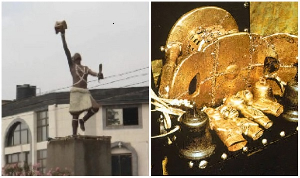 File photo of Okomfo Anokye and the Golden stool