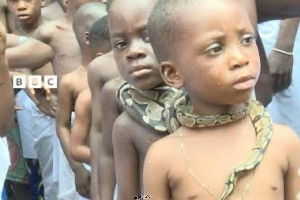
A python rests around a child’s neck, its body coiled against his shoulders. There is no panic or attempt to flee.
Instead, the child handles the reptile calmly, reflecting a tradition in which snakes are not merely feared but revered as sacred beings.
Welcome to Ouidah, a historic coastal town in Benin, where pythons occupy a special place in the spiritual beliefs and cultural traditions of the people.
At the heart of this unusual relationship is Dangbé, a sacred python deity revered by followers of the traditional Vodun religion.
Why morticians knock before entering the mortuary - Ewurabena Quartey explains
Unlike communities where snakes are viewed primarily as dangerous reptiles, some residents of Ouidah regard these animals as symbols of spiritual protection and power. Their reverence for the creatures has endured for generations.
The tradition is most visibly represented at the famous Temple of Pythons, a sanctuary that houses royal pythons regarded as sacred by the community.
Speaking in an interview with BBC News Africa, chief priest Mintode Missihoun explained the beliefs surrounding the deity and why its followers do not regard the snakes as a threat.
“Vodu Dangbe deity does not bite people and it doesn’t make anyone uncomfortable. Instead of it to bite people, it heals and protects them,” he said.
However, worshipping the deity comes with strict taboos that followers are expected to observe.
Missihoun said even his position as chief priest did not exempt him from the rules, including restrictions on sexual activity before approaching the shrine.
“Even me as a leader, I cannot sleep with a woman before coming to the deity’s shrine,” he explained.
He added that preparations for certain rituals required him to spend the night at the shrine and avoid seeing anyone before beginning the ceremonies.
The restrictions also extend to worshippers seeking answers to their prayers.
According to the priest, those who want their prayers answered must abstain from eating pepper and salt and avoid sexual relations before coming to pray.
The tradition is closely associated with the Temple of Pythons in Ouidah, where the reptiles are protected because of their spiritual significance.
For the community, the python represents more than an animal. It embodies a religious heritage preserved across generations, with rituals and taboos governing the relationship between worshippers and the deity they revere.
Watch the video below:
Somewhere in Africa, a whole community is living alongside snakes. They consider snakes as gods and they even have a festival to celebrate the snake god they call Vodu Dangbe. Children wrap the snakes around their necks without fear as part of their tradition. https://t.co/4FZ6nso0WY
— BBC News Africa (@BBCAfrica) October 10, 2026
FKA/VPO