Carlos Queiroz’s second spell as Ghana coach has opened another chapter for the Black Stars. The Portuguese coach returned to the job in September after initially stepping down following the 2026 FIFA World Cup.
But the current team is not starting from the same point as some of the celebrated Ghana sides of the past. Ghana have gone through several distinct generations since their first World Cup appearance in 2006.
Therefore, the current team is best understood by looking at how it compares with those different eras.
2006: The breakthrough generation
The modern Black Stars story began at the 2006 World Cup.
Ratomir Dujković's young Ghana side reached the Round of 16 on their World Cup debut, beating the Czech Republic and the United States before Brazil ended their run.
What the Côte d’Ivoire defeat means for Ghana's AFCON qualification journey
The team featured the emerging core of Stephen Appiah, Michael Essien, Sulley Muntari, John Mensah and Asamoah Gyan.
2008–2010: The peak
By 2008, Ghana had developed into one of Africa's strongest sides.
The Black Stars reached the AFCON semi-finals on home soil, then went all the way to the final in 2010 before losing to Egypt.
Milovan Rajevac's side subsequently produced Ghana's best World Cup performance, reaching the quarter-finals in South Africa.
The spine was established, the players were experienced and several were performing at the highest level in Europe.
2011–2017: Still an African heavyweight
The end of the 2010 World Cup did not mean the end of that strong Ghana era.
The Black Stars remained regular contenders at the AFCON.
They reached the semi-finals in 2012 and 2013, then returned to the final in 2015 under Avram Grant, losing to Côte d'Ivoire on penalties. In 2017, Ghana reached another semi-final before losing to Cameroon.
The personnel gradually changed.
Asamoah Gyan remained the central attacking figure, while André Ayew, Jordan Ayew, Christian Atsu, Kwadwo Asamoah, Mubarak Wakaso and Harrison Afful became increasingly important.
2018–2021: The decline becomes clearer
The next period was different.
Ghana failed to qualify for the 2018 World Cup, ending a run of three consecutive appearances.
The Black Stars still qualified for the 2019 AFCON, but the tournament also showed signs of decline. Ghana were eliminated by Tunisia on penalties in the Round of 16.
Then came the major warning at the delayed 2021 AFCON.
Ghana failed to win a single group game, losing to Morocco and Comoros and drawing with Gabon. The Black Stars finished bottom of their group and failed to reach the knockout stage for the first time since 2006.
2022: Otto Addo's World Cup reset
Otto Addo's first era was built around getting Ghana back to the World Cup. He succeeded, guiding the Black Stars past Nigeria in the play-offs and into Qatar.
Ghana beat South Korea 3-2 at the tournament but lost to Portugal and Uruguay and exited in the group stage. Addo left after the World Cup.
2023: Hughton and another AFCON group-stage exit
Chris Hughton then inherited the team. At AFCON 2023, Ghana again failed to reach the knockout stage.
The Black Stars lost to Cape Verde and drew with Egypt and Mozambique, finishing third in Group B with two points. It was Ghana's second consecutive AFCON group-stage exit.
2024–26: Addo returns
Addo returned in 2024 and produced two very different outcomes.
Ghana qualified for the 2026 World Cup but failed to qualify for AFCON 2025, the country's first absence from the tournament since 2004.
The Black Stars had therefore gone from four consecutive AFCON semi-final appearances between 2008 and 2013 and repeated latter-stage finishes thereafter to missing the tournament altogether.
2026: The Queiroz era
Queiroz inherited the team shortly before Ghana's 2026 World Cup campaign.
His first assignment produced a different type of Black Stars team: a mixture of established internationals such as Thomas Partey, Jordan Ayew, Gideon Mensah and Lawrence Ati-Zigi, alongside emerging players being introduced into the senior setup.
Ghana reached the World Cup knockout stage under Queiroz before losing 1-0 to Colombia.
The GFA subsequently retained him, allowing the Portuguese coach to continue building beyond one tournament.
But the biggest change under the Portuguese coach has arguably been how Ghana approach games.
Previous generations, particularly the 2006–2017 teams, were generally more willing to take the game to opponents, compete for possession and use their midfield quality to dictate play. The current Black Stars are more comfortable conceding possession, staying compact and looking to hurt opponents on the transition.
That approach was evident during the 2026 World Cup. Queiroz has defended that philosophy, arguing that controlling a game is not necessarily the same as dominating possession.
It represents a noticeable shift from the identity associated with the teams of Stephen Appiah, Michael Essien, Sulley Muntari and later André Ayew and Asamoah Gyan, who were often expected to impose themselves on opponents.
Queiroz's Ghana still has attacking talent, but the emphasis is increasingly on when to attack rather than simply having the ball.
That makes this era different from the previous cycles. The 2006 team was breaking new ground, the 2008–10 generation reached Ghana's modern peak, while the 2011–17 sides maintained the country's status as an African heavyweight.
FKA/JKB
2027 AFCONQ: Black Stars Hold First Training Session Ahead of Côte d’Ivoire Clash
Sports News of Monday, 28 September 2026
Source: www.ghanaweb.com
How Carlos Queiroz’s Black Stars era compares with previous generations
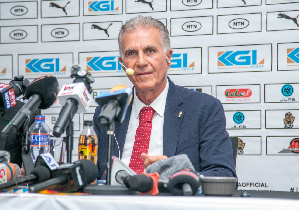
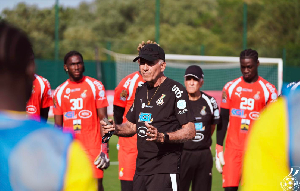 Carlos Queiroz is the head coach of the Black Stars