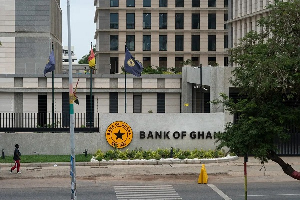
Bank of Ghana (BoG) Governor Dr Johnson Pandit Asiama has disclosed that the central bank is developing a new foreign exchange market framework that will assign GoldBod a more prominent role in forex market intermediation as authorities seek to strengthen reserve accumulation and improve market efficiency.
Speaking during the Monetary Policy Committee (MPC) media engagement, the Governor revealed that the central bank is working closely with GoldBod to refine arrangements that could reshape how foreign exchange generated from gold exports is channelled into the market.
According to him, the new framework builds on the foreign exchange management regime introduced last year, which is based on reserve accumulation, intervention and intermediation mechanisms.
“What has happened in the last one month or so is that we want to transition that framework further, where GoldBod will be playing part of that intermediation role,” Dr Asiama said.
The Governor noted that discussions between the central bank and GoldBod are at an advanced stage, with details expected to be communicated to market participants once the policy framework is finalised.
“We are in touch with GoldBod, trying to perfect that new framework. When we are ready, when it is done, we will communicate these to the markets,” he stated.
Dr Asiama also moved to reassure market participants that Bank of Ghana’s interventions in the foreign exchange market remain governed by clear rules rather than discretionary decisions.
Responding to questions on what triggers central bank interventions and how intervention volumes are determined, he said the institution operates a rules-based system under its foreign exchange management framework.
“It is not discretionary. It is not for me to just get up and say intervene. It is a clear rules-based system that we use to determine when we need to intervene,” he said.
The Governor stressed that while the central bank would continue intervening when necessary, its overriding objective remains the accumulation of adequate international reserves to support economic stability.
“Our prime objective is to build adequate reserves at all times because that is what supports our resilience as a country,” he added.
The Governor further clarified GoldBod’s role in the foreign exchange market, explaining that the state-owned enterprise would be free to sell foreign exchange proceeds to various market participants depending on the source of financing for its gold purchases.
He explained that GoldBod’s primary business is exporting gold and receiving foreign exchange earnings, making it reasonable for the institution to determine where those proceeds are sold.
“They are free to sell to Bank of Ghana. They can sell to banks,” he noted.
However, Dr Asiama indicated that financing arrangements would influence such decisions.
Where commercial banks provide financing for gold purchases, GoldBod may sell foreign exchange directly to those institutions.
Conversely, where government or central bank resources support the purchases, different arrangements may apply.
Despite this flexibility, he underscored the strategic importance of GoldBod in supporting Ghana’s reserve position.
“We would want to see GoldBod continue supporting us when it comes to reserves accumulation,” he said.
The Governor suggested that GoldBod could serve as a key support mechanism for the country’s reserve-building efforts during periods of pressure on external buffers.
According to him, there is a shared understanding between the central bank and GoldBod regarding the need to prioritise reserve accumulation whenever economic conditions require additional support.
“Whenever our reserves are challenged, GoldBod will be ready to support us,” he stated.
He added that if circumstances demanded it, the institution could direct a greater share of its foreign exchange proceeds to the central bank to help strengthen Ghana’s reserve position.
Business News of Friday, 25 September 2026
Source: businesspostonline.com
BoG signals bigger role for GoldBod in forex market reform
 Bank of Ghana's new headquarters



Entertainment