The Ghana Catholic Bishops’ Conference (GCBC) has called on government to treat the escalating illicit drug trade in Ghana as an urgent national concern, warning that it threatens the moral fabric, security and future of the country.
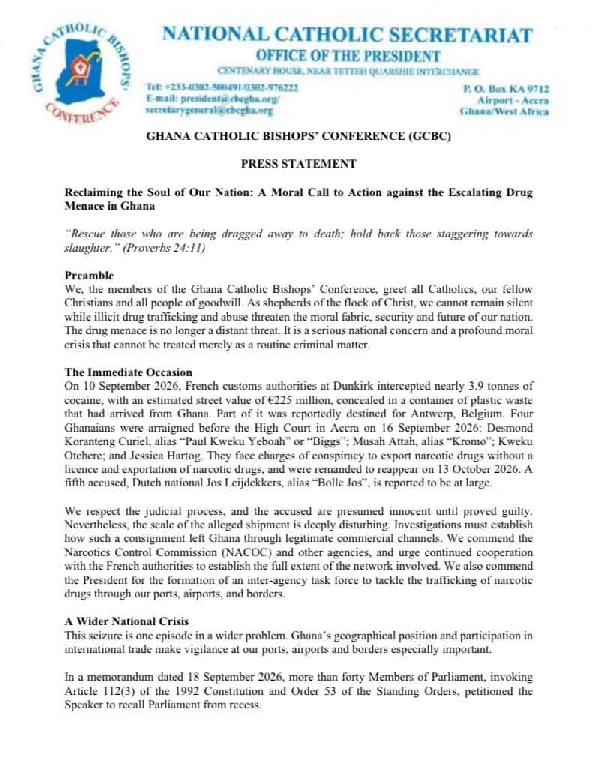
In a strongly worded press statement dated Monday, September 21, 2026, titled "Reclaiming the Soul of Our Nation: A Moral Call to Action against the Escalating Drug Menace in Ghana," the Bishops said the situation can no longer be handled as a routine criminal matter.
The statement was signed by the President of the GCBC, Most Rev Matthew Kwasi Gyamfi, Bishop of Sunyani.
The Bishops said their intervention was occasioned by the interception on 10 September 2026 by French customs authorities at Dunkirk, France, of nearly 3.9 tonnes of cocaine with an estimated street value of £225 million.
The drugs were concealed in a container of plastic waste that had arrived from Ghana, with part of it reportedly destined for Antwerp, Belgium.
Four Ghanaians were arraigned before the High Court in Accra on 16 September 2026 on charges of conspiracy to export narcotic drugs without licence and exportation of narcotic drugs and a fifth accused, Dutch national Jos Leijdekkers alias "Bolle Jos", is at large.
The Bishops said while they respect the judicial process and the presumption of innocence, the scale is deeply disturbing and places Ghana in the international spotlight for the wrong reason.
The Catholic Bishops Conference added that the recent Dunkirk seizure is part of a disturbing pattern since March 2025, as cited in a memorandum to the Speaker of Parliament by over 40 MPs seeking a recall of Parliament.
Among recent incidents cited included:
- A 3.3-tonne cocaine haul hidden under sand in a tipper truck at Pedu Junction, Cape Coast
- A second cocaine consignment intercepted on the Takoradi-Cape Coast highway
- Hundreds of parcels of suspected cocaine found in sacks of gari at a Tema Harbour warehouse
- An unresolved case involving a flight from Gran Canaria alleged to have carried narcotics and undeclared currency
- A vessel released after payment of a partial fine and later arrested abroad with narcotics
- Methamphetamine concealed in charcoal intercepted by Australian customs
Questionable involvement of public officials
The Bishops also raised alarm over the March 2026 arrest of nine public officers at Tema Port over undeclared tramadol, including five Customs officers and officers from NACOC, Port Security, the Energy Commission and Ghana Standards Authority.
They expressed concern that over a year after the Pedu Junction seizure, only a driver, a housemaid and peripheral suspects have been arraigned, while financiers remain unidentified.
Immediate demands
The GCBC, while commending NACOC and welcoming the President’s formation of an inter-agency task force, urged Government to act urgently on the following:
1.Coordinate national response: Pursue a comprehensive, coordinated strategy involving Ghana Police Service, NACOC, Customs, port authorities, judiciary and schools.
2. Enforce timely prosecution: Ensure timely, thorough investigations and prosecutions while respecting constitutional rights and judicial independence.
3. Equip borders: Provide modern scanners and surveillance tools for ports, airports and land borders to detect illicit consignments.
4. Follow the money: Strengthen cooperation with INTERPOL and Europol, investigate financial flows, and dismantle networks, not just couriers.
5. Sanction complicit officials: Investigate every public official reasonably suspected of complicity regardless of rank.
6. Address root causes: Tackle poverty, unemployment and weakened family structures that make youth vulnerable to trafficking and addiction.
The Bishops also backed the move to recall
Parliament under Article 112(3) of the 1992 Constitution to summon Ministers for Interior, Transport and National Security, as well NACOC, GPHA, GRA, GIS and NIB, to account for scanning and clearance failures.
General News of Tuesday, 22 September 2026
Source: www.ghanaweb.com
Government must treat drug menace as urgent national concern - Catholic Bishops Conference
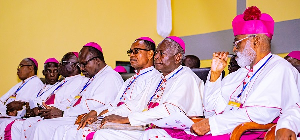 Catholic Bishops warn illicit drugs threaten Ghana’s security, moral values and future