Ghana's Catholic bishops have backed a proposed parliamentary probe into the country's drug trafficking crisis, urging lawmakers to scrutinise how narcotics consignments have passed through the country's ports and borders and to demand accountability from relevant state institutions.
The Ghana Catholic Bishops' Conference (GCBC) said Parliament's proposed inquiry was a "legitimate and necessary step" that should proceed without delay and with the cooperation of all institutions involved.
The bishops' call follows the seizure by French customs authorities on September 10 of nearly 3.9 tonnes of cocaine at Dunkirk, concealed in a container of plastic waste that had arrived from Ghana and was reportedly destined for Antwerp, Belgium.
The shipment was estimated to have a street value of £225 million ($305 million), according to the GCBC.
"Every institution must cooperate fully and transparently," the bishops said in a statement dated Monday, adding that the parliamentary process should be conducted with "sobriety" rather than partisan point-scoring.
More than 40 members of parliament have petitioned the Speaker to recall the House from recess under Article 112(3) of Ghana's 1992 Constitution and Order 53 of Parliament's Standing Orders.
The proposed parliamentary scrutiny would involve the ministers responsible for the Interior, Transport and National Security, together with officials from the Narcotics Control Commission (NACOC), Ghana Ports and Harbours Authority, Ghana Revenue Authority, Ghana Immigration Service and National Intelligence Bureau.
The bishops said Parliament should examine the adequacy of scanning, surveillance and clearance procedures at Ghana's ports and airports.
They also called on investigators to "follow the money" to identify the financiers, businesses and financial arrangements sustaining drug trafficking networks.
The GCBC urged stronger cooperation with INTERPOL and Europol in investigating transnational networks and locating wanted persons.
The bishops said the Dunkirk seizure was not an isolated incident but part of a wider pattern of narcotics cases linked to Ghana.
They cited a 3.3-tonne cocaine seizure hidden beneath sand in a tipper truck at Pedu Junction in Cape Coast, another cocaine interception on the Takoradi-Cape Coast highway and suspected cocaine found in sacks of gari at a warehouse at Tema Port.
They also referred to an unresolved case involving a flight from Gran Canaria, a vessel later arrested abroad with narcotics after being released following payment of a partial fine, and methamphetamine concealed in a charcoal shipment intercepted by Australian customs.
According to NACOC figures cited by the bishops, intelligence-led operations resulted in 217 arrests and 165 prosecutions, with more than 8.5 tonnes of assorted narcotics and 45.4 million tramadol tablets intercepted during the period under review.
Four Ghanaians arraigned
Four Ghanaians have been arraigned before Ghana's High Court following the Dunkirk seizure.
They are Desmond Koranteng Curiel, also known as "Paul Kwaku Yeboah" or "Biggy"; Musah Attah, alias "Kromo"; Kweku Otoocho; and Jessica Hartog.
They face charges of conspiracy to export narcotic drugs without a licence and exportation of narcotic drugs and have been remanded until October 13.
The bishops stressed that the accused remain presumed innocent. Dutch national Jos Leijdekkers, also known as "Bolle Jos", is reportedly at large.
The GCBC urged authorities to investigate how such a large consignment could have left Ghana through legitimate commercial channels and to work with French authorities to establish the full extent of the alleged network.
Institutional concerns
The bishops also raised concerns about the potential involvement of public officials in narcotics trafficking.
They cited a March 2026 report by the Ghana Revenue Authority on the arrest of nine public officers over a large consignment of undeclared tramadol at Tema Port.
The officials reportedly included five Customs officers and personnel from NACOC, Port Security, the Energy Commission and the Ghana Standards Authority. They were granted police inquiry bail while investigations continued.
The conference said the drug trade also posed a broader threat to Ghanaian institutions because of the financial incentives associated with trafficking.
It expressed concern that more than a year after the Pedu Junction seizure, only the driver, a housemaid and a few peripheral suspects had been arraigned, while the alleged financiers and principal traffickers remained unidentified.
"A pattern in which couriers are prosecuted while the networks that finance them escape scrutiny is the failure any credible national response must overcome," the bishops said.
The GCBC also called for greater investment in prevention and rehabilitation, urging government agencies, schools, families and religious organisations to intensify efforts to protect young people from drug abuse.
"The response must be firm and lawful, but also preventive, rehabilitative and rooted in respect for human dignity," the bishops said.
General News of Tuesday, 22 September 2026
Source: asaaseradio.com
Catholic Bishops back parliamentary probe into Ghana’s drug trafficking crisis
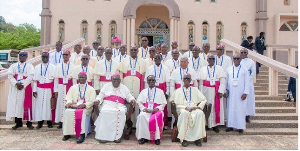 A file photo of Ghanaian Catholic bishops