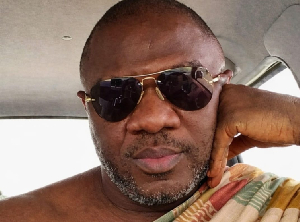
After more than 18 months of trial, the prosecution in the case of Republic v. Kwabena Adu-Boahene & Others has closed its case, bringing to an end the State’s presentation of evidence.
The prosecution called four witnesses, including Economic and Organised Crime Office (EOCO) lead investigator Frank Marshall Cromwell, whose evidence came under intense scrutiny during several weeks of cross-examination by defence counsel.
At the centre of the case is the prosecution’s allegation that GH¢49.1 million was unlawfully transferred from what it described as a “STATE BNC” account into a UMB account allegedly operated as a private account by former National Security operative Kwabena Adu-Boahene and his wife, Angela Adjei-Boateng.
The prosecution has further alleged that the money was subsequently dissipated through the acquisition of properties, vehicles and other assets, including properties in London, Mayfair, Oyarifa and Kumasi, as well as the Kobby Keach Hotel and Dorchester Heights.
However, evidence elicited from the prosecution’s own witnesses, particularly during cross-examination, has raised questions about several key aspects of the State’s case.
No government agency or account known as “STATE BNC” established
One significant issue to emerge from the evidence is the description of the account from which the GH¢49.1 million originated.
Both the Head of Finance at the National Security establishment and EOCO’s investigator acknowledged that no government agency or account formally known as “STATE BNC” had been established in evidence.
The account in question was identified as a National Security special operations account held at Fidelity Bank.
Adu-Boahene did not have unilateral control of the originating account
Evidence before the court also established that the Fidelity Bank account had three signatories: then National Security Coordinator Joshua Kyeremeh, Head of Finance Seth Danso, and Kwabena Adu-Boahene.
The evidence was that two signatures were required to authorise withdrawals from the account.
Based on the evidence presented, Adu-Boahene therefore did not have the authority to unilaterally withdraw or transfer funds from the account.
GH¢49.1m cheques were not signed by Adu-Boahene alone
The three cheques relating to the GH¢49.1 million were signed by Joshua Kyeremeh and co-signed by Adu-Boahene.
The Head of Finance also testified that she prepared and wrote the cheques before they were presented for signature.
The evidence therefore showed that the movement of the funds involved more than one authorised signatory.
Head of Finance deposited two cheques into UMB account
Another important aspect of the evidence concerned who actually paid the cheques into the UMB account.
EOCO’s investigator confirmed that the Head of Finance personally deposited two of the three cheques into the UMB account.
The account was described in evidence as an operational account within the National Security space, although the Head of Finance said she did not have clearance to know the details surrounding its operations.
National Security operatives operated the supposedly “private” account
The investigator also admitted that National Security operatives, including Gerald Osei Tutu and Denise Blackson, conducted transactions on the UMB account.
More than GH¢109 million was withdrawn from the account by National Security operatives for what was described as special operations.
This has raised a central question in the case: if the account was a private account belonging to Adu-Boahene and his wife, why were National Security operatives using it for special operations?
Four descriptions, one account number
The UMB account was referred to by different names during the investigation and trial.
Among the descriptions used were:
BNC Operations Account;
Bureau of National Communications – Operations;
BNC Ops; and
Private BNC.
However, the descriptions referred to the same account number.
A significant point emerging from the evidence is that banking transactions are effected through account numbers rather than merely the descriptions or names attached to accounts.
No alternative account identified
Under cross-examination, the EOCO investigator was asked which account the GH¢49.1 million was supposed to have been paid into if the UMB account was not the proper account.
He was unable to identify an alternative account.
No other account into which the money ought to have been deposited was established through the evidence.
Private character of UMB account not established
The prosecution’s investigator was also unable to demonstrate conclusively that the UMB account had been improperly created or operated as a private account by Adu-Boahene and his wife.
Significantly, the National Security Coordinator signed the cheques that were deposited into the account.
The investigator also acknowledged that he did not interview Seth Danso, a co-signatory to the originating Fidelity Bank account, or members of the top hierarchy of the National Security establishment regarding critical aspects of the account and its operations.
Mayfair payments predated GH¢49.1m transfer
The prosecution also sought to rely on payments relating to Mayfair properties.
However, during cross-examination, the investigator admitted that the Mayfair receipts relied upon by the prosecution were dated 2016 and 2018.
The GH¢49.1 million cheques were issued later.
On the evidence presented, therefore, the Mayfair payments predated the GH¢49.1 million transaction and were not shown to have been funded from those monies.
No property conclusively linked to GH¢49.1m
The EOCO investigator was unable to produce title documents establishing that the properties allegedly attributed to Adu-Boahene and his wife in Mayfair, Oyarifa, Kumasi and London were acquired with the GH¢49.1 million.
The evidence did not establish a direct financial trail linking the disputed funds to the acquisition of those properties.
No vehicle purchase linked to the funds
Similarly, the investigator was unable to demonstrate that any specific vehicle was purchased with the GH¢49.1 million.
While the prosecution has alleged that the funds were used to acquire vehicles and other assets, the evidence presented did not establish a direct link between the disputed funds and any particular vehicle.
Purpose of GH¢49.1m not conclusively established
Perhaps one of the most significant issues arising from the evidence concerns the purpose for which the GH¢49.1 million was intended.
The prosecution has alleged that the money was meant for the procurement of a cyber-defence system.
However, under cross-examination, the investigator was unable to establish that the entire GH¢49.1 million was exclusively earmarked for that purpose.
This issue is significant because the prosecution’s case rests, in part, on the allegation that the funds were diverted from their intended state purpose.
What remains of the prosecution’s case?
After more than 18 months of evidence, the prosecution has now closed its case.
The evidence presented has established that GH¢49.1 million was transferred through banking transactions. However, several critical questions surrounding the legal character of the accounts, the authority under which the funds were transferred, their intended purpose and their alleged use remain contested.
Based on the evidence elicited during cross-examination, the prosecution did not establish that:
a government agency or account formally known as “STATE BNC” existed;
the GH¢49.1 million originated from an account belonging to a government agency described as “STATE BNC”;
Adu-Boahene had unilateral control over the Fidelity Bank account from which the money originated;
Adu-Boahene alone authorised or signed the cheques transferring the money;
there was another identified account into which the GH¢49.1 million ought to have been paid;
the UMB account was conclusively established to be an unauthorised private account operated by Adu-Boahene and his wife;
withdrawals from the UMB account by National Security operatives were unrelated to official special operations;
the more than GH¢109 million withdrawn from the UMB account was unrelated to National Security operations;
the Mayfair payments were funded from the GH¢49.1 million;
any particular property or vehicle was demonstrably acquired with the GH¢49.1 million; or
the entire GH¢49.1 million was exclusively earmarked for the alleged cyber-defence procurement.
What happens next?
With the prosecution having closed its case, the proceedings have now moved to the next stage.
The defence has been directed by the court to file its written submissions in support of its submission of no case to answer by September 25, 2026.
The court has subsequently adjourned the matter to November 5, 2026, when it is expected to rule on the defence’s submission of no case to answer.
General News of Tuesday, 8 September 2026
Source: www.ghanaweb.com
Adu-Boahene Trial: What we know after 18 months of prosecution's case
 Kwabena Adu-Boahene was former National Signals Bureau boss under ex-president Akufo-Addo






Opinions