The Ghana Catholic Bishops’ Conference (GCBC) has rejected calls for the resignation of Chief Justice Paul Baffoe-Bonnie, describing such demands as disproportionate to the offence.
The Conference said although the head of the Judiciary must be cautious about making statements that could create perceptions of partisan bias, his recent controversial remarks do not, on their own, constitute evidence that the Chief Justice is partisan or that the Judiciary has been compromised.
The controversy follows comments made by Justice Baffoe-Bonnie on September 2, 2026, during working visits to the Social Security and National Insurance Trust (SSNIT) and the Minerals Income Investment Fund (MIIF).
His reference to the “past eight years” during the visits was interpreted by some critics as a political comparison between the performance of previous and current administrations.
In a statement, the Catholic Bishops’ Conference stressed that judicial independence requires not only actual impartiality but also the appearance of impartiality.
“The Judiciary must be and must be seen to be, above the partisan contest.”
The Bishops, however, said the incident should not be interpreted as proof of political bias or judicial capture.
“We wish to be clear that none of this amounts to a suggestion that the Chief Justice is partisan, or that the Judiciary has been compromised. Such conclusions would go well beyond the evidence available to us and calls for his resignation on this basis alone strike us as disproportionate to the offence.”
According to the Conference, Justice Baffoe-Bonnie, like any other citizen, is entitled to hold his own personal convictions. However, his position as head of the Judiciary places an additional responsibility on him to ensure that his public conduct does not create reasonable doubts about his neutrality.
https://www.ghanaweb.com/GhanaHomePage/NewsArchive/Cheap-Justice-Prof-Kwesi-Yankah-raises-4-explosive-concerns-about-Baffoe-Bonnie-s-conduct-2051051
“The Chief Justice, like any citizen, is entitled to his own convictions. The question is not whether he may hold them but whether his public conduct in office should ever create room for reasonable doubt about where he stands.”
The Bishops acknowledged that visits by the Chief Justice to state institutions such as SSNIT and MIIF are legitimate and appropriate.
However, they cautioned that introducing political comparisons during such engagements could undermine public confidence in the Judiciary, particularly because the courts may be required to adjudicate disputes involving the government, political parties and public institutions.
“Judicial independence is not only a matter of actual impartiality; it also depends on the visible, unmistakable appearance of impartiality,” the Conference stated.
AM
#TrendingGH: 'Revisit the case' - Netizens react to controversial court ruling
General News of Monday, 7 September 2026
Source: www.ghanaweb.com
'Chief Justice is entitled to his own convictions' - Catholic Bishops reject calls for resignation
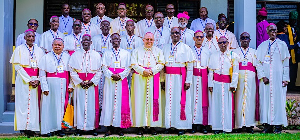 Members of the Ghana Catholic Bishops’ Conference




Entertainment