The Judicial Service has clarified recent remarks by Chief Justice Paul Baffoe-Bonnie made about the performance of some state-owned institutions, saying his observations were made in good faith and were not intended to undermine judicial independence.
The clarification follows public criticism of comments the Chief Justice made during visits to the Social Security and National Insurance Trust (SSNIT) and the Minerals Income Investment Fund (MIIF) on Wednesday, September 2, 2026.
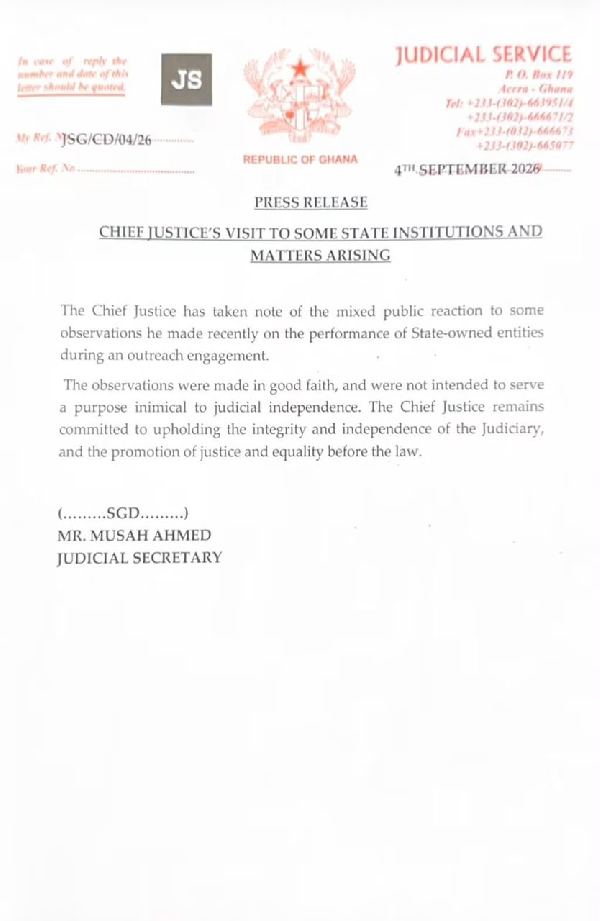
In a statement issued on Friday, September 4, 2026, by the Judicial Secretary, Musah Ahmed, the Chief Justice acknowledged the mixed public reaction to his comments and sought to put the remarks into context.
The statement indicated that the observations by the Chief Justice were made in good faith and were not intended to undermine judicial independence.
The Chief Justice also reaffirmed his commitment to preserving the integrity and independence of the Judiciary, as well as promoting justice and equality before the law.
“The Chief Justice has taken note of the mixed public reaction to some observations he made recently on the performance of State-owned entities during an outreach engagement.
“The observations were made in good faith, and were not intended to serve a purpose inimical to judicial independence. The Chief Justice remains committed to upholding the integrity and independence of the Judiciary, and the promotion of justice and equality before the law,” the statement read.
CDD-Ghana urges Chief Justice to avoid comments that create perception of political bias
The controversy stems from comments made by the Chief Justice during an outreach engagement with state institutions, where he appeared to compare their current performance with what he described as the situation in the past eight years under the Akufo-Addo-led administration.
At MIIF, the Chief Justice praised the institution’s current management but questioned what had been achieved during what he referred to as the “past eight years.”
He similarly made observations during his visit to SSNIT, where he referred to previous attempts to dispose of some of the institution’s assets and expressed concerns about the state of affairs under the previous management of the country.
His comments subsequently attracted political and public attention, particularly because of the politically sensitive nature of the issues he touched on.
Some stakeholders, particularly members of the New Patriotic Party (NPP), expressed concern that the remarks could have implications for perceptions of the Judiciary and the office of the Chief Justice.
They argued that comments by the head of the Judiciary on matters involving the performance of governments and state institutions could be interpreted as taking a position on politically contested issues.
According to the critics, such interventions risk creating the impression that the Judiciary is aligning itself with one side of the political debate, potentially affecting public confidence in its neutrality.
Some NPP members have therefore described the comments as unbecoming of the leader of the Judiciary, warning that politically sensitive commentary from the Chief Justice could undermine the revered nature of the office and raise questions about judicial independence.
They have particularly raised concerns about the potential impact of such statements on public confidence in the Judiciary, arguing that the Chief Justice, as the head of the country’s judicial system, must be seen to remain above partisan political disagreements.
Transport operators threaten higher fares amid rising fuel prices
AK/AM
General News of Saturday, 5 September 2026
Source: www.ghanaweb.com
Judicial Service breaks silence on CJ’s ‘SOEs doing better than past 8 years’ remarks
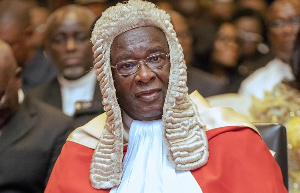 Paul Baffoe-Bonnie is the Chief Justice of Ghana’s Supreme Court.