Professor Jason Arday, the British-born Ghanaian academic who became the University of Cambridge’s youngest Black professor, has died at the age of 41.
Arday was appointed to Cambridge’s Faculty of Education in March 2023 at the age of 37, becoming one of the youngest Black academics to hold a professorship at the prestigious university.
His death comes after a career that took him from a difficult childhood in south London to the upper reaches of British academia, where he became known for his work on race, education, inequality and social justice.
Here are 6 things to know about the late professor
1. He was born to Ghanaian parents.
Arday grew up on a council estate in Clapham, south London, in a Ghanaian family. His mother, Gifty, was a mental health nurse, while his father, Joseph, worked as a chef.
His upbringing was strongly influenced by his mother’s activism. She was involved in anti-racist activism and took part in protests alongside community activists, exposing Arday from an early age to issues surrounding race, equality and social justice.
2. He was diagnosed with autism as a child
Arday was diagnosed with autism and global developmental delay when he was three.
He did not speak until he was 11 and could not read or write until he was 18. As a child, he was taught sign language and underwent thousands of hours of speech therapy.
He later credited his mother with playing a crucial role in helping him develop speech, including using music and song lyrics to help him understand language.
a href="https://www.ghanaweb.com/GhanaHomePage/NewsArchive/British-born-Ghanaian-Cambridge-professor-found-dead-after-allegations-of-plagiarism-2047800" target="_blank">British-born Ghanaian Cambridge professor found dead after allegations of plagiarism
Doctors had reportedly given his family bleak expectations about his future, including the possibility that he would require assisted living.
Instead, Arday went on to build a career in higher education and became an outspoken advocate for greater inclusion and opportunities for marginalised communities.
3. He worked as a cleaner and at Sainsbury’s
Arday’s route into academia was far from conventional. Before establishing himself as a professor, he worked in jobs outside academia, including as a late-night cleaner and, as recently as 2016, as a trading assistant at Sainsbury’s.
He also experienced the insecurity associated with academic employment, including working on zero-hours contracts.
He described having a personal mantra during those difficult years: “It won’t always be like this.”
4. A lecturer helped change his life
One of the people who played an important role in Arday’s educational journey was sports lecturer Sandro Sandri.
After a careers office had suggested that Arday might only be suited to volunteer work, his mother sought another opportunity for him.
Arday eventually enrolled at Merton College in Morden, south London, where he met Sandri.
Sandri worked with him on his literacy skills and encouraged him to pursue his potential. According to Arday, Sandri repeatedly told him that he was capable of achieving great things.
The lesson Arday took from that relationship was that he should extend the same support to others.Before joining Cambridge, Arday held professorships at the University of Glasgow and Durham University.
He also authored three academic books, with much of his work focusing on race, education and inequality.
At Cambridge, his official position was Professor of the Sociology of Education. His work focused on issues including social justice and intersectional inequalities.
He also worked with organisations and initiatives seeking to improve opportunities for marginalised groups, including the Black Curriculum and the Runnymede Trust.
5. He was passionate about widening access to education
Arday viewed his position at Cambridge not simply as a personal achievement but as an opportunity to challenge barriers within elite educational institutions.
He spoke about the need to “democratise higher education” and wanted more young people from marginalised backgrounds to gain access to spaces historically dominated by privileged groups.
His approach included working with schools and encouraging young people from under-represented communities to see themselves as belonging in elite educational institutions.
8. He raised millions through charity work
Beyond academia, Arday had a strong record of charitable work.
He raised more than £5 million through charity-related activities and was particularly known for combining his academic career with fundraising and community work.
In 2010, he ran 30 marathons in 35 days to raise money for charity.
For Arday, such achievements were less about intellectual ability than determination. He often emphasised the importance of perseverance and using one's opportunities to help others.
Arday’s appointment at Cambridge attracted considerable attention, particularly because of his background as a Black British academic and his experiences with neurodivergence.
He acknowledged the symbolic importance of his appointment to Black communities and the wider African diaspora.
He also spoke about the pressure that came with being viewed as a symbol of Black achievement.
Rather than seeing his appointment simply as an individual triumph, he argued that people from marginalised backgrounds should use positions of influence to create opportunities for others.
JKB/VPO
BizTech: Ghana’s STEM revolution and building the workforce of tomorrow
General News of Saturday, 15 August 2026
Source: www.ghanaweb.com
6 things to know about the British-born Ghanaian professor who died at 41
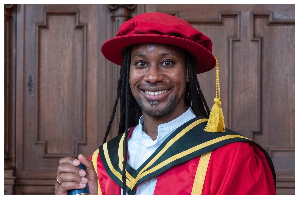 Former Cambridge professor Jason Arday, a British-born Ghanaian academic, has died at 41




Entertainment