The Attorney General has announced working with US authorities to pursue people allegedly involved in the bribery scheme linked to the financing of a major Turkish power plant, following the conviction of a Ghanaian-American businessman in Brooklyn, New York.
But there are fears that the matter would be caught up in elite consensus, as both the ruling National Democratic Congress (NDC) and the opposition New Patriotic Party (NPP) politicians were deeply involved in the transaction and might not want the reports naming them as alleged recipients of the bribes.
Deputy Attorney-General Justice Srem Sai disclosed that Attorney-General Dr Dominic Ayine was engaging his US counterparts following the conviction of the former Goldman Sachs executive, Asante Kwaku Berko, concerning the AKSA power project in Ghana, in which, according to US prosecutors, the businessman participated in a scheme involving more than US$1 million in payments to Ghanaian officials to secure approvals for the project.
Berko, a former managing director of the Tema Oil Refinery (TOR) and a dual US-Ghanaian citizen, was found guilty by a federal jury in New York of conspiring to violate the US Foreign Corrupt Practices Act (FCPA), violating the FCPA, and conspiring to commit money laundering.
Interestingly, the first Mahama government brought in the AKSA power project in 2015 through Berko; however, the Akufo-Addo government appointed him as MD of the TOR, and he was enjoying his office until the bribery allegation surfaced in 2022, leading to his dismissal from TOR, subsequent arrest in the UK, and extradition to the US for prosecution.
He had bypassed Goldman Sachs, his employers; gained the trust of the Turks; and had them win the AKSA power project by bribing Ghanaian officials.
Ghana’s Parliament approved the power plant agreement in July 2015. US prosecutors presented emails in which Berko and his alleged co-conspirators discussed the illicit payments, calling them the “holy rain”.
For example, in August 2015, they discussed US$250,000 in bribe payments to various individuals, including US$46,000 paid by Berko himself to members of the Ghanaian Parliament who ratified the agreement between Aksa and the Government of Ghana.
During the same month, the co-conspirators also discussed how one bribe recipient was waiting for the “holy rain” – a coded reference to the bribe payment – and “would appreciate it sooner rather than later”.
To conceal the scheme from Goldman Sachs and others, Berko allegedly lied to the bank’s compliance team responsible for vetting the transaction. He also used his personal email account, rather than his Goldman Sachs business account, to discuss the deal and the bribe payments, while directing his co-conspirators to do the same.
In addition, Berko and his co-conspirators allegedly concealed and laundered the bribe payments through shell companies, sham invoices, nominee account holders, and cash withdrawals.
Payments made in furtherance of the bribery scheme were laundered through US and foreign bank accounts. Goldman Sachs ultimately withdrew from the transaction because of corruption concerns and reported the matter to investigators.
The Herald has since intercepted excerpts from a June 2015 memorandum submitted to Parliament by the then Minister for Power, Dr Kwabena Donkor, which provides fresh details of the Government’s emergency power agreement with Turkish energy company AKSA Enerji Üretim AŞ.
The documents show that the initial agreement, which provided up to 370 megawatts (MW) of installed power generation capacity on a fast-track basis, was part of the Government’s response to Ghana’s severe power crisis at the time, called “Dumsor”. It was phrased “take or pay,” putting the country in what seems like a perpetual bond.
The Herald’s information is that since that initial transaction, AKSA’s power-generation footprint in Ghana has grown from 370MW to about 1,500MW. More recently, the company has received government support to proceed with plans for a much larger 900MW power project in Takoradi, further expanding its presence in Ghana’s power sector.
The memorandum, dated 15 June 2015 and addressed to Parliament, was titled: “Emergency Power Agreement with Attached Annexes Between the Government of Ghana (Ministry of Power) and Aksa Enerji Üretim AŞ for the Provision on a Fast-Track Basis, up to 370MW (ISO) Installed Capacity of Power Delivery Services.”
At the time, the Parliamentary Select Committee on Mines and Energy was chaired by Alhaji Amadu Bukari Sorogho, then the Member of Parliament for Madina on the NDC ticket.
The Ranking Member was K.T. Hammond, then the NPP MP for Adansi Asokwa, while Adam Mutawakilu served as Vice-Chairman and Joseph Cudjoe as Deputy Ranking Member, with the NDC MP for Damongo in the Savannah Region, currently the Ghana Water MD, and NPP MP for Effia in the Western Region, respectively.
Dr Donkor is currently the board chairman of Ghana Amalgamated Trust, a Ghana Government-based private equity model to support selected indigenous banks.
In the memorandum, Dr Donkor explained that the implementation of the Emergency Power Agreement (EPA) with AKSA was intended to increase Ghana’s generation capacity at a time when the country was battling a debilitating power crisis.
“The implementation of the EPA Agreement will enhance generation capacity, which is very critical, particularly in our quest as a nation to end the energy challenge,” the memorandum stated.
It added that the agreement would reduce the impact of the power crisis on the economy, particularly the industrial sector, while contributing to job creation.
According to the document, the Ministry of Power engaged relevant stakeholders in the power sector during inter-ministerial consultations on the agreement.
The Public Utilities Regulatory Commission (PURC) was among the stakeholders consulted.
The agreement was also reviewed by a team comprising officials from the Ministry of Power, the Ministry of Justice and the Attorney-General’s Department, the Volta River Authority (VRA) and the Electricity Company of Ghana (ECG).
The memorandum further stated that discussions were ongoing with the Ministry of Finance concerning the financial terms of the agreement.
Technical teams from the VRA, Ghana Grid Company (GRIDCo), and AKSA had, according to the memorandum, agreed on the project’s technical design and were ready for implementation.
The documents also reveal that the project had received Executive Approval from the Presidency before Parliament was asked to approve the agreement.
A letter dated 2 June 2015 and referenced OP/CA20 stated that the President had granted Executive Approval for the Government of Ghana, represented by the Ministry of Power, to execute the Emergency Power Agreement with AKSA.
The letter, signed by the then Secretary to the Cabinet, Roger K. Angsomwine, was addressed to the Minister for Power.
It referred to an earlier letter from the Ministry dated 26 May 2015 concerning the proposed agreement.
“His Excellency the President has granted Executive Approval for Emergency Power Agreement (EPA Agreement) to be executed between the Government of Ghana (GoG) represented by the Ministry of Power and AKSA Enerji Üretim AŞ (AKSA),” the letter stated.
The Secretary to the Cabinet subsequently directed the Minister to take the necessary steps to give effect to the Executive Approval.
Copies of the communication were also sent to the Chief of Staff, the Secretary to the President, the Secretary to the Vice-President, and the Senior Policy Adviser/Head of the Policy Delivery Unit.
The memorandum stated that Parliament’s approval was sought due to the power crisis’s negative effects on the Ghanaian economy.
“Considering the negative effects of the ongoing load shedding on the economy,” Parliament was respectfully requested to approve the Emergency Power Agreement dated 12 May 2015 between the Government of Ghana, represented by the Ministry of Power, and AKSA.
The agreement was therefore presented to Parliament against the backdrop of the severe load-shedding regime that had affected households, businesses, and industry.
The 2015 documents are significant in the context of AKSA’s subsequent expansion in Ghana.
What began with an agreement for up to 370MW of fast-track power-generation capacity has since grown into a much larger footprint, with AKSA’s installed or contracted generation capacity in Ghana reaching about 1,500MW.
The company’s expansion has also continued to attract government attention, with plans for a further 900MW power project in Takoradi receiving government support.
The growth of AKSA’s presence in Ghana’s power sector is now likely to attract renewed public scrutiny, particularly against the background of the original emergency power agreement and the circumstances under which it was negotiated, reviewed, and approved.
The 2015 memorandum provides a contemporaneous account of the Government’s justification for bringing AKSA into Ghana’s power-generation sector and shows that the agreement received Executive Approval before being submitted to Parliament for consideration.
Referring to his boss, the Deputy Attorney-General, Justice Srem Sai, said, “The Attorney-General is engaging his counterparts in the United States of America to bring to book persons implicated in the bribery scheme,” Srem Sai said in a Facebook post on Saturday, August 8, 2026.
It is unclear whether Dominic Ayine, who entered Parliament on January 7, 2013, after winning his Bolgatanga East Constituency seat on the NDC ticket in the December 2012 general elections, participated in the deliberation on the Turkish power plant.
The nine-day trial centered on allegations that Berko helped arrange financing for a multimillion-dollar power plant in Ghana between 2014 and 2017, while working as an executive director at Goldman Sachs.
Berko was found guilty of conspiracy to violate the US Foreign Corrupt Practices Act (FCPA), violating the FCPA, and conspiracy to commit money laundering. Justice Srem Sai said Mr Ayine was working with US authorities to pursue other persons who may have been implicated in the alleged scheme.
The conviction followed a nine-day trial before Judge Diane Gujarati of the US District Court for the Eastern District of New York.
According to the US Department of Justice (DOJ), Berko played a central role in a scheme involving more than US$1 million in alleged bribes to Ghanaian government officials to secure approval for a multimillion-dollar power plant project.
Prosecutors said Berko, an Executive Director at Goldman Sachs, helped facilitate a financing arrangement between a Turkish energy company and the Government of Ghana for the construction of a power plant at a time when the country was experiencing a severe electricity crisis. Evidence presented at the trial indicated that Berko and his co-conspirators allegedly planned to pay US$1 million to Ghana’s Minister of Power in April 2015.
Prosecutors further alleged that five Ghanaian government officials each received US$5,000 during an all-expenses-paid trip to Turkey to inspect equipment for the proposed project. The court also heard that Berko personally paid tens of thousands of dollars in additional alleged bribes linked to the transaction.
Parliament approved the power plant agreement in July 2015, after which prosecutors presented emails in which Berko and his alleged co-conspirators discussed the illicit payments.
The US Department of Justice said Berko took steps to conceal the alleged bribery scheme from Goldman Sachs and other parties involved in the transaction. Prosecutors said shell companies, fraudulent invoices, nominee bank accounts, and cash withdrawals were used to disguise the alleged payments.
The DOJ also said the funds were moved through bank accounts in the United States and other countries, including accounts held in Berko’s name. Goldman Sachs subsequently withdrew from the transaction after corruption concerns emerged.
Convicted Berko faces a maximum sentence of 30 years in prison when he is sentenced in November. His criminal conviction follows an earlier civil enforcement action by the US Securities and Exchange Commission (SEC) over the same allegations.
In June 2021, the SEC obtained a final judgment against Berko, permanently barring him from violating the anti-bribery provisions of the FCPA and ordering him to disgorge US$275,000 in alleged illicit gains, together with more than US$54,000 in prejudgment interest.
Berko was extradited to the United States from the United Kingdom in July 2024 after being arrested in London in November 2022 under an Interpol Diffusion Notice. US authorities condemn corruption. Assistant Attorney General Tysen Duva of the DOJ’s Criminal Division said the conviction demonstrated the consequences of corruption that undermines fair competition.
“We live in a global economy that American companies must be able to compete in fairly. This defendant corrupted that fair competition. He abused his position at a world-renowned American investment bank by helping bribe Ghanaian officials, so he and his co-conspirators, including senior executives at a Turkish company, could make money.” He added that individuals who undermine US interests through corruption “will face the full force of the Department of Justice.”
Acting Assistant Director of the FBI’s Criminal Division, Matthew Floyd, also criticised Berko’s conduct. “Berko intentionally lied to his company to continue his scheme. The FBI will not tolerate dishonesty or corruption from anyone who wishes to disturb the business market.”
The case was prosecuted by the US Attorney’s Office for the Eastern District of New York and the Fraud Section of the DOJ’s Criminal Division. Berko’s conviction has renewed attention on the circumstances surrounding the power plant agreement and the alleged involvement of Ghanaian officials. The Attorney-General’s engagement with US authorities could lead to further investigations and possible prosecutions of other individuals found to have participated in the alleged bribery scheme.
The Attorney-General’s cooperation with US authorities could lead to further investigations and possible prosecutions if evidence shows that others participated in the alleged bribery scheme.
General News of Monday, 10 August 2026
Source: theheraldghana.com
Dr Kwabena Donkor, MPs 'fingered' in dumsor-era US$1 million bribery allegation
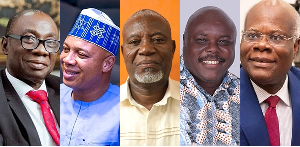 A photo collage of some NDC, NPP members