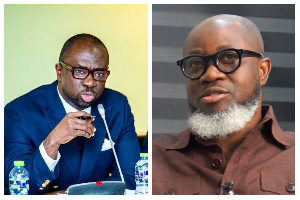
Private legal practitioner Professor Stephen Kwaku Asare has stated that the conviction of former Goldman Sachs banker Asante Kwaku Berko in the United States should serve as a major lesson for Ghana in the fight against corruption.
His comments come on the back of Berko’s recent conviction by a federal jury in Brooklyn for violating the US Foreign Corrupt Practices Act (FCPA) and related offences arising from more than $1 million in bribes allegedly paid to Ghanaian government officials in connection with a power plant project.
FULL TEXT: Former TOR MD convicted of foreign bribery and money laundering
According to Kwaku Azar, the case shows that corruption should not be viewed as the wrongdoing of only the person who receives a bribe.
He said the person who offers or pays the bribe is equally part of the corrupt transaction and must be held accountable where the evidence supports it.
“The good book says for every briber there is a bribee. Bribery, unlike alikoto, is usually a game for at least two… The giver and the taker are partners in the corrupt transaction. A serious anti-corruption system must therefore have eyes for both hands,” he wrote in a Facebook post on Sunday, August 9, 2026.
Azar also believes that Ghana must strengthen its laws and enforcement practices to ensure that both foreign companies that bribe Ghanaian officials and officials who accept such payments can be pursued.
He said it should not matter whether the person who offers the bribe is a Ghanaian or a foreigner if the transaction involves the corruption of Ghanaian public power.
“Our laws and enforcement practices should therefore make it unmistakably clear that where the evidence permits, Ghana can pursue both the foreign briber and the Ghanaian bribee,” he said.
He also said Ghana must examine its laws to ensure that Ghanaian citizens and companies that bribe officials in other countries can also be held accountable.
“We should therefore examine whether our laws provide sufficiently clear and effective jurisdiction over foreign bribery committed by Ghanaian citizens and companies abroad,” he stated.
Azar further argued that corruption investigations can involve several countries and cannot always be handled with a purely domestic approach.
He noted that money, emails, bank records, intermediaries, and other evidence may be located outside Ghana. The indictment in the Berko case, he said, alleged that money moved through correspondent banks in New York on its way to Ghana.
Azar therefore urged Ghanaian authorities to make use of evidence gathered by foreign investigators when such evidence relates to suspected corruption involving Ghana.
He said authorities should ask foreign investigators what evidence they obtained and what that evidence establishes under Ghanaian law.
Azar added that Ghana must improve the way it traces money in corruption cases, suggesting that investigations should not end with identifying the person who handed over or received cash, because corrupt funds can move through companies, consultants, bank accounts, and intermediaries.
‘Holy Rain’ - How ex-Goldman Sachs banker coded $1m bribe payments in Ghana power deal
“Modern corruption investigations cannot end with Who handed the envelope to whom? Money moves through companies, consultants, bank accounts, relatives, intermediaries, and jurisdictions… Sometimes the envelope disappears. The bank transfer does not,” he stated.
He said anti-corruption efforts must therefore work together with money-laundering laws, beneficial ownership rules, proceeds-of-crime laws, corporate liability, and asset recovery.
Read his full post below:
MAG/EB
#TrendingGH: 'Revisit the case' - Netizens react to controversial court ruling
General News of Sunday, 9 August 2026
Source: www.ghanaweb.com
What Asante Berko’s conviction means for Ghana – Kwaku Azar breaks it down
 Professor Stephen Kwaku Asare is a legal practitioner