Executive Director of the Energy Transition, Sustainable Energy and Mines Project Africa, Luqman Abubakari, has welcomed the recent two-cedi reduction in fuel prices but cautioned against any attempt by the government to recover the relief through the introduction of new petroleum taxes.
According to him, while the reduction offers temporary relief to consumers, the key concern should be the sustainability of such interventions without placing additional financial burdens on Ghanaians.
"The two-cedi reduction is a very good move, but I don't want it to come in the form of a petroleum tax for consumers," he said.
Dangote to build $16 billion East African refinery in Kenya by October
Speaking in an interview on TV3 on Friday, August 7, 2026, Abubakari stressed the need for Ghana to strengthen its petroleum storage capacity to better respond to global supply disruptions and price volatility.
He explained that expanding the country's bulk oil storage facilities, alongside efforts to increase local refining capacity, would enable Ghana to maintain strategic fuel reserves that could be released during emergencies to cushion consumers.
"If we have a way of increasing our bulk oil storage capacity, just as we are trying to expand the capacity of the Tema Oil Refinery to refine more crude, it will be better," he said.
He noted that several countries maintain strategic petroleum reserves that are deployed during periods of supply shocks to stabilise domestic markets.
"When they are faced with emergencies of this nature, they release some stock into the system to cushion their citizens. If we can do this in a very subtle manner, it will help us," he said.
Abubakari also renewed calls for a review of the tax components in Ghana's fuel pricing structure, describing the current number of levies as excessive.
According to him, the Energy Sector Levies Act (ESLA) already imposes significant costs on consumers, adding that there are about 12 active taxes in the fuel price build-up.
"ESLA alone is significant. We have about 12 active taxes on our fuel price window. That is too much for the consumer," he said.
However, he questioned whether the government has the financial capacity to sustain such relief measures over time.
"Two cedis is okay, but how sustainable is this? Do we have some free money somewhere that we can continue to use to take care of consumers?" he questioned.
ANAS/MA
Ghana's recovery due to superior economic management - Ato Forson
Business News of Friday, 7 August 2026
Source: www.ghanaweb.com
'GH¢2 fuel reduction is good, but how sustainable is it?' - Energy expert
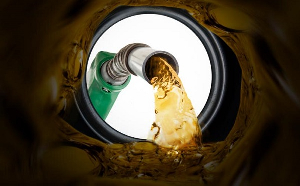 File photo of fuel pump