The June 29 floods were caused by a rare weather system that Ghana Meteorological Agency (GMet) has described as a “classical textbook case” of how prolonged rainfall and high accumulation can result in severe impacts.
Joshua Asamoah, Senior Meteorologist in charge of Public Weather and Warnings at GMet, said the storm was unusual because it moved slowly over a small area, lasted for several hours and produced an extreme amount of rainfall within a short period.
In an interview on TV3 monitored by GhanaWeb on July 9, 2026, he explained that while the agency had predicted the likelihood of above-normal rainfall months before the event, the severity of the flooding was linked to the amount of rain that fell within a short period and how long the storm remained over the affected areas.
"That event is the classical textbook case of how duration and accumulation of rainfall play a part in the impact that we see across the country.
"This is a case where you had a slow-moving storm, moving over a short space, lasting a lot of hours, producing a high amount of rainfall and leading to a high impact," he said.
'It was not of natural cause' - Evangelist claims June 29 floods backed by 'spiritual forces'
He described the June 29 rainfall as one of the rare weather events that meteorologists often study because such storms do not frequently occur in real-life situations.
According to him, Accra recorded more than 150 millimetres of rainfall in a single day, an amount that is close to what some areas receive in an entire month.
"It produced over 150 millimetres of rainfall in just Accra, just one day. In perspective, this is close to what you get in a whole month in some years. But we had that in just a single day. So that's quite an extreme event that we had in Accra on that particular day," he said.
Asamoah clarified that although the rainfall was among the highest recorded in Accra in recent years, it was not the highest rainfall recorded in Ghana.
"It is the highest in Accra for some few years. I think it's the fourth highest rainfall we've seen in Accra. If you move to other places in the country, Axim and Takoradi this year have recorded over 200 millimetres in a single day," he explained.
He noted, however, that those areas did not experience the same level of destruction because Accra's situation was different.
"That's because our case is a bit peculiar compared to the other areas in Ghana," he added.
The meteorologist said GMet had anticipated above-normal rainfall conditions along Ghana's eastern coast, including Tema, Accra, Ada and parts of the Volta Region, through its seasonal forecast issued between February and March.
"The seasonal forecast is where we predict how the season is going to look like. From March, April, May, June, July to August, we give an outlook of how rainfall will look like for people who are in southern Ghana," he said.
"We anticipated above-normal rainfall for areas in the eastern coast of Ghana, and that is actually what we saw."
Beyond seasonal predictions, Asamoah said GMet also provides shorter-range forecasts, including two-week, weekly, daily forecasts and nowcasts covering periods between zero and six hours.
He explained that weather forecasting involves collecting historical data on weather conditions such as rainfall, temperature, atmospheric pressure and wind before using mathematical models based on physical laws to predict future conditions.
"Forecasting starts from what happened in the past. A simple mathematical formula for forecast is yesterday plus or minus today. That gives you what the future is going to look like," he said.
He added that no weather forecast anywhere in the world is 100 per cent accurate because of uncertainties in atmospheric conditions.
"There is no 100 per cent accurate forecast anywhere. But when a forecast is issued at a shorter range, the accuracy is always better," he said.
Asamoah revealed that GMet's long-range forecasts currently achieve about 80 per cent accuracy, while short-term warnings are continuously assessed using rainfall measurements and feedback from affected communities.
"When we send forecasts that it is going to rain in an area, we have platforms where we get feedback from people. We also have rain gauges in these areas measuring the amount of rainfall that we get. We use that information to validate the forecast," he said.
He added that the validation process helps the agency identify weaknesses in its forecasting models and improve future weather predictions.
The Minister for the Interior, Mohammed-Mubarak Muntaka, has disclosed that recent flooding incidents across Ghana have claimed 29 lives, with six people still missing.
Speaking recently before Parliament's Public Assurance Committee, the minister said the fatalities were recorded in separate flood disasters in the Greater Accra, Central and Volta regions.
According to him, the Central Region suffered one of the worst flood disasters a week before the June 29 floods in Accra, resulting in the deaths of 18 people and the collapse of dozens of houses.
JKB/VPO
LIVESTREAMING: GhanaWeb launches maiden Real Estate Platform
General News of Thursday, 9 July 2026
Source: www.ghanaweb.com
GMeT explains rare weather event behind June 29 floods
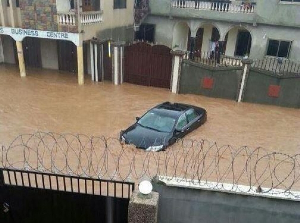 A car submerged by floodwaters during the recent floods






Opinions