When the first FIFA World Cup kicked off in Uruguay in 1930, the tournament looked nothing like the spectacle that will unfold in 2026.
There were no giant video screens. No goal-line technology. No VAR reviews. No cooling breaks. Not even lightweight boots.
Instead, players ran around in thick cotton shirts, heavy leather boots and shorts that would look more at home in a history museum than on a modern football pitch.
Even the referees looked different.
Dressed in long-sleeved shirts and formal-looking attire, officials relied solely on their eyesight and a whistle. If a goal was offside or a foul was missed, there was no replay to save them. Their decision was final.
Why Derrick Luckassen and Brian Brobbey have different last names despite being brothers
As the world prepares for another month of football drama, it is worth remembering just how far the World Cup has travelled.
The players of 1930 would barely recognize the game.
Back then, football boots were built more for protection than performance. Made from thick leather and rising above the ankle, they resembled work boots. Once rain began to fall, they absorbed water and became even heavier. A sprint in those conditions was a test of endurance.
The ball was no kinder.
Constructed from leather panels stitched together by hand, it became increasingly heavy during matches.
Heading it was often painful. In wet weather, it could feel like striking a rock with your forehead.
Yet those pioneers laid the foundation for what would become the world’s biggest sporting event.
As the decades passed, innovation slowly reshaped the tournament.
The 1950s and 1960s brought lighter boots and improved equipment. By the 1970 World Cup in Mexico, Adidas had introduced the iconic Telstar ball, the first World Cup ball designed specifically for television audiences.
Its black-and-white pattern became one of football’s most recognizable images.
Then came the television revolution.
Millions became billions.
World Cup matches that were once witnessed by spectators inside stadiums could now be watched across continents.
The tournament was no longer just a football competition. It became a global event.
The players changed too.
Heavy cotton shirts gave way to lightweight synthetic kits designed to improve performance.
Boots became lighter, faster and more colourful. Sports science entered football, transforming preparation, nutrition and recovery.
Goalkeepers evolved from brave shot-stoppers into athletes capable of launching attacks with their feet.
Referees also entered the modern age.
Gone were the days of long sleeves and guesswork. Officials began using communication systems, electronic substitution boards and eventually video technology to assist decision-making.
Then came some of the biggest changes in World Cup history.
Goal-line technology made its debut in 2014, ensuring that disputes over whether the ball crossed the line became a thing of the past.
VAR followed in 2018, allowing officials to review major incidents.
By 2022, semi-automated offside technology and sensor-equipped match balls were helping referees make decisions with unprecedented accuracy.
The World Cup that arrives in 2026 is therefore more than just another tournament.
It is the latest chapter in a story that began with leather balls, heavy boots and referees in long sleeves.
Nearly a century later, football’s greatest stage is powered by cameras, sensors, data and technology that the pioneers of 1930 could never have imagined.
But amid all the changeS, one thing has remained exactly the same.
The dream.
Whether it was a player stepping onto the field in Montevideo in 1930 or a superstar preparing for kick-off in 2026, the feeling is unchanged.
The World Cup still has the power to stop nations, create heroes and produce moments that live forever.
The boots may be lighter. The balls may be smarter. The referees may have technology on their side.
But the magic remains timeless.
FKA/JE
Two rescued, one in critical condition after building collapse at Avenor
Sports News of Monday, 8 June 2026
Source: www.ghanaweb.com
Long-Sleeved Referees, Heavy boots: How the World Cup became a modern spectacle
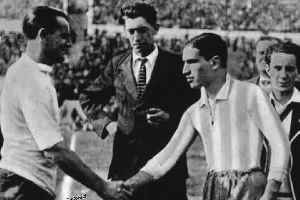 Referees and players during the 1930 World Cup