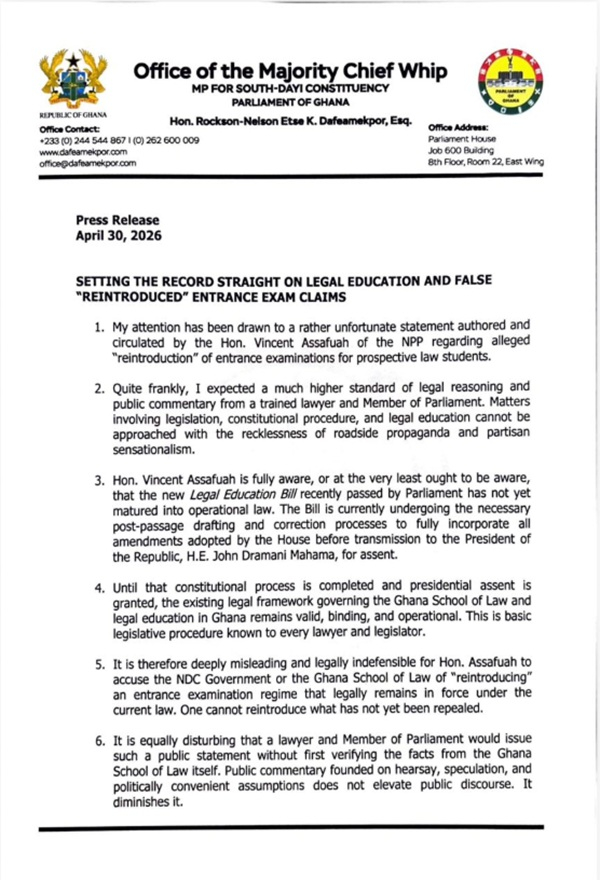
The Majority Chief Whip of Parliament, Rockson-Nelson Dafeamekpor, has dismissed reports suggesting that the government has reintroduced entrance examinations for prospective law students, describing the claims as false and politically motivated.
In a press release issued by the Majority in Parliament on April 30, 2026, the South Dayi MP said assertions that a new exam regime has been introduced under the administration of John Dramani Mahama are not supported by law or current developments.
His comments were in response to allegations by Vincent Assafuah, the Member of Parliament for Old Tafo, who claimed that entrance exams had been reinstated for admission into the Ghana School of Law.
'No Makola', National Bar Exams and More: What the Legal Education Bill 2025 brings
Dafeamekpor clarified that the recently passed Legal Education Bill has not yet come into force, as it is still undergoing post-passage processes, including drafting corrections and incorporation of amendments.
He explained that the bill must complete these steps before being presented to the president for assent.
“Until that constitutional process is completed and presidential assent is granted, the existing legal framework governing legal education in Ghana remains valid and operational,” he stated.
He argued that it is “deeply misleading and legally indefensible” to suggest that the government has reintroduced entrance exams, noting that such a system is still legally in place and has not been repealed.
“One cannot reintroduce what has not yet been repealed,” he emphasised.
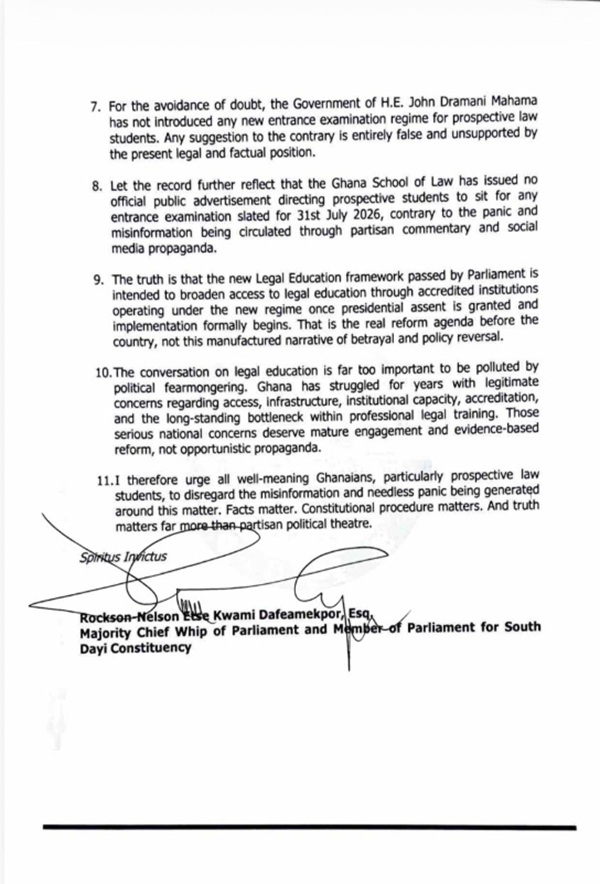
The Majority Chief Whip also noted that the Ghana School of Law has not issued any official communication requiring applicants to sit for an entrance examination scheduled for July 31, 2026.
He attributed the reports to what he described as misinformation driven by partisan commentaries and social media narratives.
What the new Legal Education Bill 2025 means for students, politicians and legal experts
According to Dafeamekpor, the proposed reforms under the Legal Education Bill are aimed at expanding access to legal education through accredited institutions once the law is fully enacted and implemented.
He urged stakeholders to focus on substantive issues affecting legal education; such as access, infrastructure, institutional capacity, and accreditation, rather than what he called “manufactured narratives.”
Rockson-Nelson Dafeamekpor further advised prospective law students and the general public to disregard the claims, stressing the importance of relying on verified information.
“Facts matter. Constitutional procedure matters. And truth matters far more than partisan political theatre,” he said.
Read statement below
VPO/AE
A Plus Bares It All: From politics to showbiz and beyond
General News of Friday, 1 May 2026
Source: www.ghanaweb.com
‘Deeply misleading’ – Dafeamekpor scolds Old Tafo MP over law entrance exams claims
 Rockson-Nelson Dafeamekpor is the Majority Chief Whip in Parliament