Yaw Appiah, a young man who operated a bar, has been awarded compensation of GH¢800,000 by the Supreme Court after he was wrongfully convicted and spent about 19 years in prison.
According to a starrfm.com.gh report on Monday, April 27, 2026, Appiah was initially acquitted and discharged by the Court of Appeal in 2025 after serving years in prison for an offence he did not commit.
Man regains freedom after 19 years in jail for a crime he didn’t commit
He was convicted in 2011 and handed a 45-year sentence for robbery when he was 29 years old.
Before the conviction, he had already spent five years on remand following his arrest in 2006.
The report added that in total, Appiah spent nearly two decades at the Nsawam Prison before the Court of Appeal described his conviction as a “tragedy” and cleared him of all charges.
After his acquittal, his lawyers, Augustine Obour and Claudia Coleman, filed an application at the Supreme Court seeking compensation of GH¢2,020,800 on his behalf.
The prosecution, led by Principal State Attorney Nana Adoma Osei, however, argued for a lower amount, proposing between GH¢75,000 and GH¢100,000.
The five-member panel of the Supreme Court, presided over by Justice Avril Lovelace-Johnson, ultimately fixed compensation at GH¢800,000, relying on the legal principle in the Dodzi Sabbah case.
The panel also included Justice Prof Henrietta Mensa-Bonsu, Justice Samuel Asiedu, Justice Yaw Darko Asare, and Justice Kweku Tawiah Ackaah-Boafo.
Barker-Vormawor leads man wrongly kept in prison for 7 years to sue police, government for GH¢9.9m
The court delivered its ruling on February 10, 2026, under Article 14(5) and (7) of the 1992 Constitution, which provides for compensation for unlawful arrest, detention, or conviction.
MAG/VPO
'President Mahama wasn't my friend initially' - Julius Debrah recounts
General News of Monday, 27 April 2026
Source: www.ghanaweb.com
Wrongfully convicted bar operator awarded GH¢800k compensation after 19 years in prison
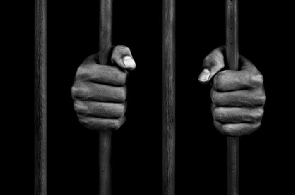 A file photo of someone behind bars