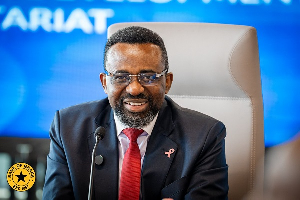
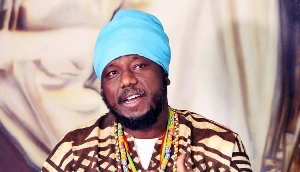
Samuel Atta Akyea, lead counsel for former National Signals Bureau (NSB) Director-General, Kwabena Adu-Boahene, has accused the Economic and Organised Crime Office (EOCO) of concealing evidence, following the Accra High Court’s admission of the full complement of Adu-Boahene’s bank statements, despite objections from the Attorney-General’s office.
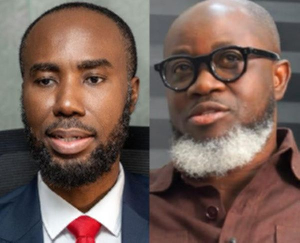
The development follows court proceedings on March 17, 2026.
Presiding judge, Justice Francis Apangabuno Achibonga, ruled to allow the tendering of additional bank records identified as Exhibit 6K, despite objections from the Attorney-General’s representatives.
The court held that while procedural rules require that a document be introduced through its author or recipient, the overriding consideration of relevance justified its admission as being “partial in evidence.”
The ruling came during cross-examination of the prosecution’s key witness, Edith Ruby Opokua Adumuah, Head of Finance at the NSB, by defence counsel, Samuel Atta Akyea.
The proceedings form part of the ongoing high-profile criminal trial involving Adu-Boahene and two others, with the State represented by the Office of the Attorney-General, led in court by counsel Esi Yankah and Radiatu Abdulai, in the absence of Deputy Attorney-General Justice Srem-Sai.
Court admits 'omitted' UMB bank statements of Adu-Boahene into evidence
During cross-examination, Atta Akyea led the witness through a series of financial transactions captured in previously admitted exhibits, particularly those linked to what was described as the “Director BNC Account” and the National Security Coordinator’s special operations account.
However, the defence introduced what it described as a more comprehensive version of Adu-Boahene’s bank records, arguing that disclosures made by the Economic and Organised Crime Office (EOCO) through the Attorney-General were incomplete.
Atta Akyea drew the court’s attention to the alleged discrepancies between the duration indicated on the cover page of the prosecution’s disclosure, January 2017 to February 2025, and the actual bank statements provided, which spanned only from August 18, 2023, to April 28, 2025.
The prosecution’s witness conceded under questioning that the statement in Exhibit 6K did not fully account for the entire period referenced.
The defence sought to tender what it described as the “full and comprehensive” bank statement, arguing that the court must have access to all relevant material in the interest of justice.
However, the Attorney-General’s team initially objected to the tendering of the additional bank records, arguing that the witness was neither the author nor custodian of the documents and therefore not competent to introduce them under the National Reconciliation Commission (NRC) Act, 2002 (Act 611).
Counsel Atta Akyea countered that the documents’ highlighting what he termed as gaps in EOCO’s disclosures and stressing that excluding them would impede the court’s ability to trace the full financial flows.
Presiding Judge Francis Apangabuno Achibonga acknowledged the tension between procedural rules and the need for comprehensive evidence, ruling that since portions of the bank statements had already been tendered, the full documents should also be admitted.
Consequently, the comprehensive bank statements, marked Exhibit 6 series (6K–6N), were admitted into evidence, ensuring the court had access to the complete financial record.
Read the full court ruling below:
AM/VPO
Meanwhile, learn of the story of the man behind the iconic Akwaaba frames in Ghana:
General News of Wednesday, 18 March 2026
Source: www.ghanaweb.com
Atta Akyea 'battles' Attorney General in court
 The development follows court proceedings on March 17, 2026