The Head of Economics Department at University of Professional Studies Accra (UPSA), Professor Abdullah Mumuni, has warned that the surge in shopping malls – particularly foreign-owned ones – could threaten local manufacturing if government fails to demand they source a quota of their products locally.
Speaking exclusively to Business and Financial Times (B&FT), Prof Mumuni admonished government to leverage the surge in foreign-owned shopping malls to boost domestic manufacturing. He asserted that a mandatory quota for locally-made goods would spur domestic production, economic growth and job creation.
He added that government could support these mall operators – those that have the capacity – in setting up factories to produce locally.
“We should push for them to establish industries here and produce locally. They can start with their plants and everything,” he advised.
Establishing local factories, Prof Mumuni noted, would increase government revenue, strengthen the cedi by reducing import-driven forex pressure and contribute significantly to the country’s GDP.
He noted: “It takes time for all these things. So if they start with 30 to 40 percent, they can increase the quota over time”.
Currently, the foreign-owned malls that operate in Ghana import most of their products, rendering local manufacturers uncompetitive due to high unit cost of domestic production that stifles the local industry, he noted.
Importation does the economy more harm than good as it depletes substantial foreign currency for products which can be produced locally, he said.
This situates Ghana in a dilemma of sacrificing local economies on the altar of a more fomalised and taxable form that has the potential to create a lot of jobs.
Economy: Nigeria to record fastest growth in 2026 — World Bank.
“When it comes to employment, tax payment, revenue… they contribute a lot,” he said.
Prof Mumuni noted that the high production cost which resulted in the surge of foreign-owned shopping malls is pricing local producers into extinction.
“Our prices generally are not competitive. It’s not because of quality, but generally the price level. Our unit cost locally is normally high,” the economist said.
He explained that the cost problem is systemic and will require deliberate policy interventions to improve the entire business environment.
“It is woven into the very fabric of doing business in Ghana, fuelled by crippling expenses for electricity, taxes, water, rent and transportation,” he added.
The consequence, he said, is a market where even basic goods like toothpicks and snacks are more profitable when imported than produced locally. “They import Shito. They import toothpicks. It’s not that we cannot produce them here. It’s because we are not able to compete,” Prof. Mumuni noted.
If income levels in Ghana are low and the cost of business is prohibitively high, why are foreign retailers – particularly from China – flooding in?
The renowned economist dismantled the notion of a rapidly expanding middle-class as the primary driver of these foreign investors. He identified political stability, cheap labour and market size as drivers of the influx.
“Investors are looking at national income data. GDP per capita will serve as a guide,” he explained.
Compared to neighbouring markets, Ghana has a larger, more stable and peaceful consumer base, he added.
Prof Mumuni intimated the high unemployment rate among youths guarantees cheap labour and high profit margins for foreign firms, noting that these make importing finished goods attractive despite the low average income.
He maintained that government policy also contributes to the underperforming local industry.
He described the business environment in Ghana as a punitive system that targets the compliant while there is widespread evasion.
“We pursue those who are actually paying to pay more. Those who are not paying at all still don’t pay,” he said, citing the recent increase in electricity and water tariffs.
According to him, these inflate the operational costs for formal businesses – making their products uncompetitive.
The analyst rejected the idea that local markets like Makola face imminent extinction, citing enduring consumer segments which value quality and the fact that foreign malls don’t carry all local goods.
However, he noted that: “If you are not ready to bring down your price, you will be out-competed from the market”.
Business News of Wednesday, 14 January 2026
Source: thebftonline.com
Surge in malls poses risk to local production – Prof Mumuni
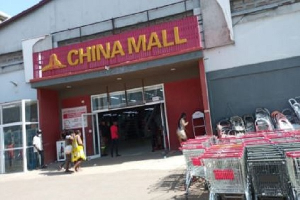 File photo: Entrance of a China mall